
Close your eyes and picture a diamond. Chances are, you’re seeing a perfectly symmetrical circle flashing back light with mirror-like intensity. The round brilliant cut has become our collective idea of how an ideal diamond should look. This classic diamond shape sets the benchmark for sparkle, and it’s not hard to see why.
The modern round brilliant diamond was engineered over decades to do one thing exceptionally well: return as much light as possible to the eye. Every angle, every facet, every millimeter of its proportions was refined to bring out the very best in a naturally formed diamond that began its life deep within the Earth millions to billions of years ago.
In this guide, we’ll explain what a round brilliant diamond is, break down the essential round brilliant cut proportions, explain why it’s the only shape awarded an official GIA cut grade and unpack the question many couples quietly Google such as ‘Are round diamonds more expensive?’
What is a round brilliant diamond?
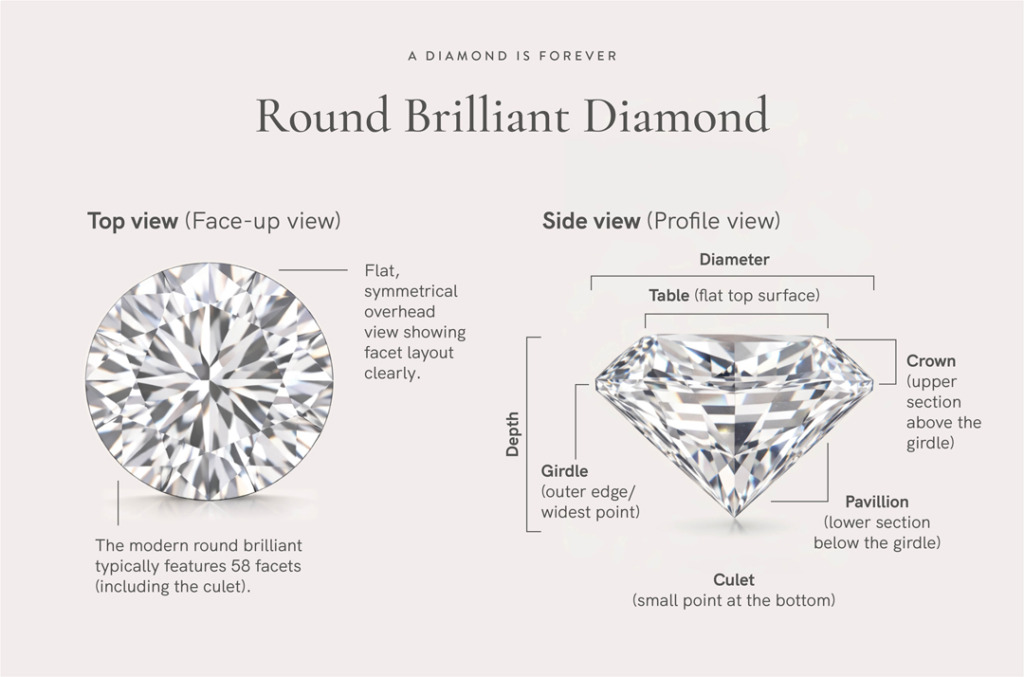
A round brilliant diamond is a circular shaped gem cut with 58 carefully calibrated facets, designed to return as much light as possible to the eye. Out of all the diamond shapes, the round brilliant is a classic for a reason. No other cut has been studied, refined and perfected to this degree.
Three parts do the heavy lifting: the table (the flat top), the crown (which creates fire) and the pavilion (which reflects light back upward). When those angles work in harmony, the diamond delivers balanced white brilliance and flashes of color1.
It’s also the only shape with an official cut grade from the Gemological Institute of America (GIA)2, one that assesses how well a diamond’s proportions, symmetry and finish work together to reflect light, giving buyers a consistent, recognized standard for comparison that no other shape offers. That combination of measurability and meaning only deepens when you consider what the natural diamond itself represents. Formed over millions to billions of years beneath the earth’s surface, a round brilliant is then shaped by extraordinary human skill, with each of its 58 facets angled exactly right to reflect light back through the crown, transforming a rough natural crystal into something that appears to glow from within.
It’s also the only shape with an official cut grade from the Gemological Institute of America (GIA), which makes it one of the easiest diamonds to compare confidently3. Add that precision to a natural diamond formed millions to billions of years ago, and you have something that emanates a sublet kind of power: nature shaped by exacting human hands.
The blueprint behind the sparkle
There’s something unexpectedly romantic about the diamond history of the round brilliant and the fact that this enduring symbol of modern proposals began not with emotion but with mathematics.
In 1919, Belgian mathematician Marcel Tolkowsky calculated the proportions of a round brilliant cut diamond to ensure each one reached its optimal light performance potential; mapping out the 58-facet structure that remains the industry standard today. His research turned light into a formula and gave the round brilliant its edge.
More than a century later, that blueprint still underpins the way we judge sparkle. Not trend, not guesswork,but exact precision4.
What makes a round brilliant cut look so bright?
When we talk about sparkle, we’re really talking about three things:
Brilliance
It’s the bright white light that reflects straight back to your eye, clean and sharp with a mirror-like diamond clarity5.
Fire
A scatter of tiny rainbow flashes that spark and disappear as the light hits6.
Scintillation
Flickers of light and dark as the diamond moves. That restless, always alive quality7.
The 58-facet design of the round brilliant cut was engineered to return light with remarkable efficiency. Every angle has a job to do.
Polish and symmetry refine that performance. When facets are precisely aligned and beautifully finished, the sparkle feels crisp and highly defined rather than soft or hazy.
Other shapes can be striking, but the round brilliant remains the reference point for consistent light return. It’s where the relationship between proportion and performance is most clearly understood, and where diamond cutting reveals brilliance in its most refined form.
What to look for in a round brilliant diamond
A round brilliant cut is engineered for light, but small shifts in proportion can change how that light behaves. This is where the details start to matter.
Table percentage
The table is a large, flat facet on top of the diamond. It acts as a window, shaping how much light returns to your eye and how its fire appears.
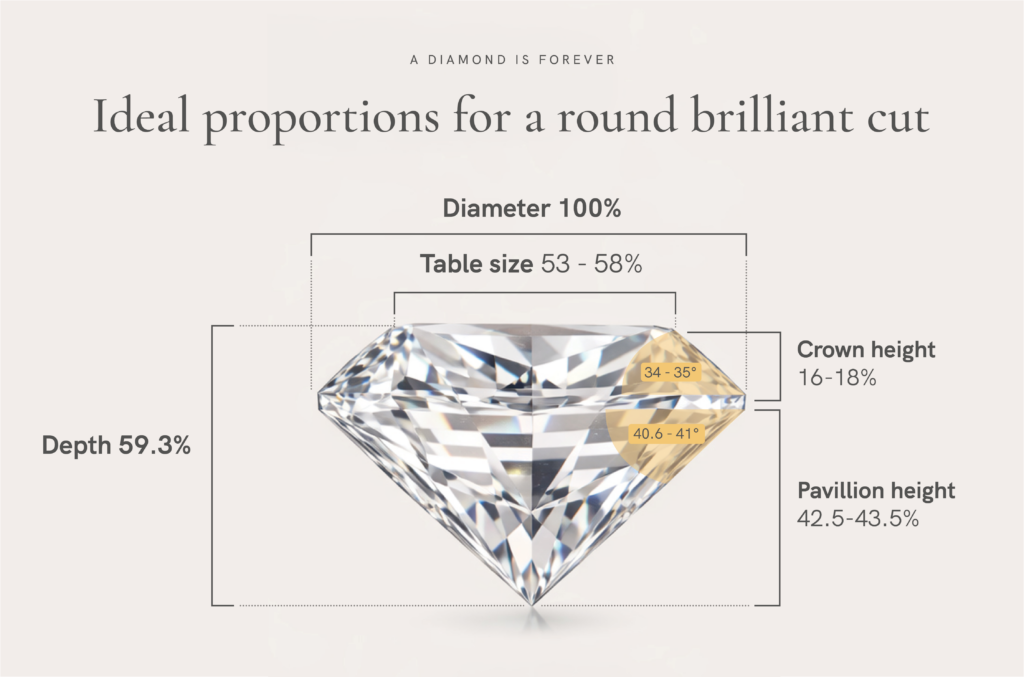
For a round brilliant cut diamond, an ideal table percentage typically falls between 53 percent and 58 percent. In this range, you’ll see a balanced mix of white brilliance and color. Too large and the diamond can look flat or glassy. Too small and sparkle can soften.
The table must work in harmony with the crown and pavilion, so use the percentage to narrow your options, then check the diamond in motion8.
Depth percentage
Depth is the distance from the table to the culet, expressed as a percentage of the diamond’s diameter.
For a round brilliant cut diamond, depth usually sits between about 59 percent and 62.5 percent. Go too deep, and the diamond can appear smaller than its carat weight suggests, with weight tucked underneath. Too shallow and the sparkle can lose its sharpness9.
ADIF tip: Don’t judge size by carat alone. Check the millimeter measurements. Two diamonds with the same weight can look noticeably different on the hand, depending on the depth.
Crown angle
The crown is the upper section of the diamond, and its angle subtly shapes how light is expressed. It’s what gives a round brilliant cut diamond its sculpted brightness and those sharp flashes of color.
In a well-proportioned round brilliant cut diamond, the crown angle typically sits around 34 to 35 degrees, with a height of roughly 16 to 18 percent of total depth. In this range, fire feels lively without overpowering the white brilliance.
Crown angle only tells part of the story. It needs to be read alongside the pavilion angle beneath it. The real beauty lies in the relationship between the two, not in chasing a single number10.
Pavillion angle
The pavilion is the lower half of the diamond, and it does most of the heavy lifting when it comes to light return. Get it right, and light reflects back through the top in a bright, even flash.
In a well-proportioned round brilliant cut diamond, pavilion depth typically sits around 42.5 percent to 43.5 percent, with an angle of roughly 40.6 to 41 degrees. In this range, brilliance feels balanced and consistent.
When the pavilion is out of sync, light can leak from the bottom or sides, leaving the diamond looking dimmer or with a darker center. Like the crown angle, it’s best judged as part of the overall balance11.
Symmetry and polish
Symmetry is about precision. It’s how perfectly the facets align and how balanced the pattern looks when the diamond is viewed face-up. In a beautifully cut round brilliant, everything feels centered and composed, with light moving evenly across the surface.
Polish is the finish. Each facet is smoothed to a reflective sheen. When polish is strong, the sparkle looks sharp and defined. When it isn’t, the light can appear slightly softened, particularly close-up.
Both are graded from Poor to Excellent. For that clean, refined brilliance the round brilliant is known for, Good or above is the smart place to start12.
Common proportion red flags
Consider this your quick-scan list. Most round brilliants are cut to impress, but if something feels slightly off when you look at it, these are the usual suspects.
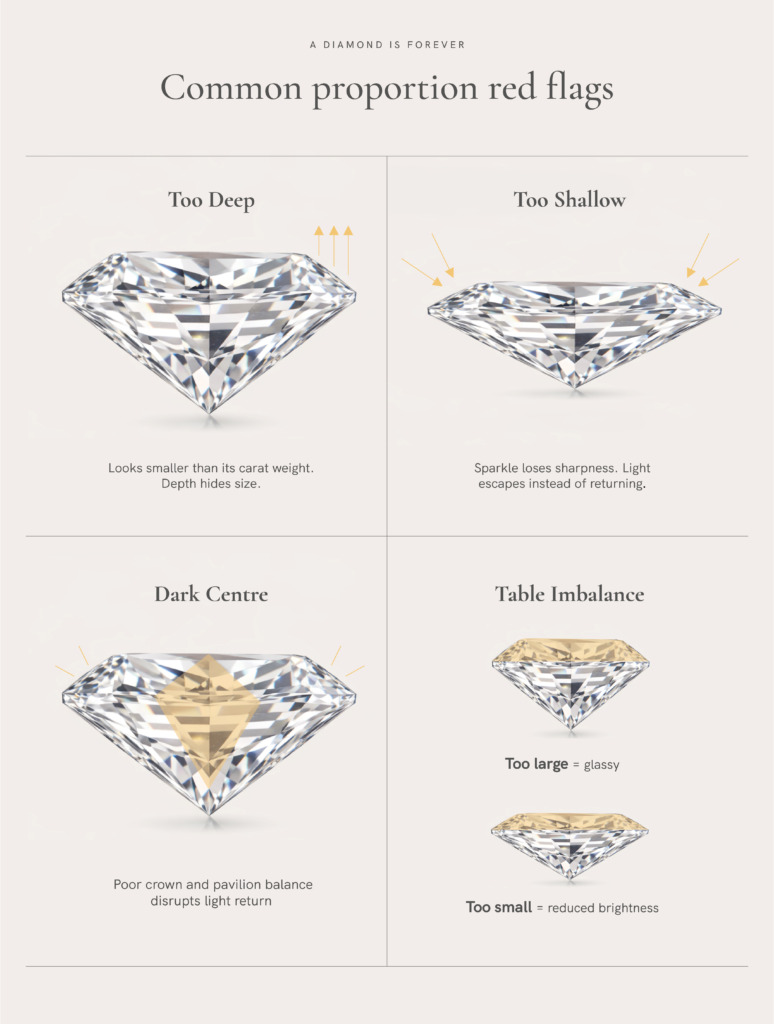
Too deep
A diamond that appears smaller than its carat weight often carries excess depth. More of the weight sits below the girdle, rather than presenting itself across the top.
Too shallow
When a diamond is cut too shallow, brilliance can lose definition. The overall look may feel softer, even slightly washed out13.
Dark center or uneven brightness
A visible shadow through the middle or patchy light return suggests the crown and pavilion angles aren’t working in harmony. A well-cut round should appear bright and even from edge to edge14.
Table imbalance
An overly large table can give a flatter, glassier appearance. Too small and face-up brightness may dip. The table should always be assessed in context with the overall proportions15.
GIA cut grade: the fastest way to judge a round
Start with GIA cut grade
If you’re not sure where to begin, the GIA cut grade is the quickest way to assess the light performance of a round brilliant cut without getting lost in technical detail.
For most people, Excellent is the natural starting point: the grade where brightness, fire and balance come together at their strongest.
Very Good can be considered an alternative if you’re managing a budget, as long as the diamond still looks bright and even in real-world lighting16.
Check for Triple Excellent
If you want a simple shortcut, look for Triple Excellent. That means Excellent cut, Excellent polish and Excellent symmetry on the grading report.
It’s not about chasing perfection for the sake of it. It’s about reducing guesswork. Triple Excellent rounds tend to deliver that clean, crisp, high-definition sparkle without needing to analyze every proportion in detail17.
How the round brilliant cut is styled today
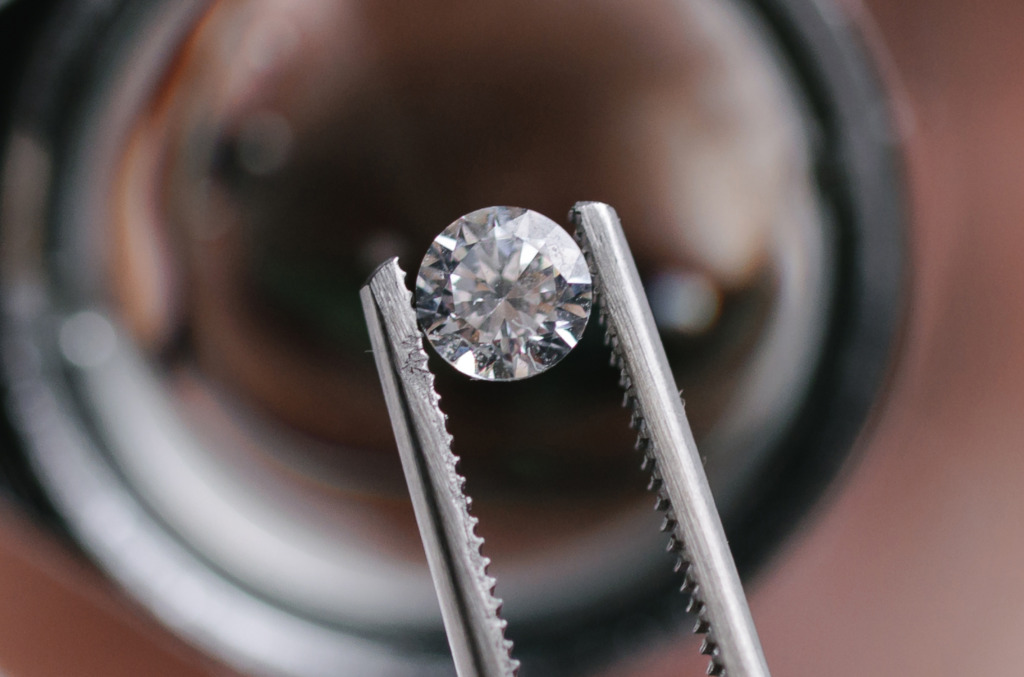
The round brilliant cut is fine jewelry’s quiet constant, prized for its precision and unmistakable shine.
GIA-graduate gemologist and fourth-generation diamantaire Olivia Landau describes it as a choice for someone “drawn to a classic and timeless style,” noting that its brilliant faceting delivers the kind of maximum sparkle that never date18.
You see that quiet confidence in singer Dua Lipa’s round brilliant cut diamond engagement ring set into a wide yellow-gold band, which adds a modern elegance to the timeless diamond cut.


A classic center, reimagined
Australian model Miranda Kerr’s refined round brilliant, flanked by tapered baguettes, shows how beautifully the classic center gem can be framed by contrasting shapes. The round remains the focal point, while the baguettes add structure and sophistication.
That instinct to frame rather than replace the round is shaping modern design. “Recently, we have created a few engagement rings that feature classic round diamonds, but we pair them with really unexpected and unusual side diamonds, such as kites,” says Baylee Zwart, the designer behind AZLEE Jewelry. “It makes the round diamond feel new and adds an interesting element, which still utilizes a classic shape.”19
The silhouette remains timeless. The styling evolves around it.

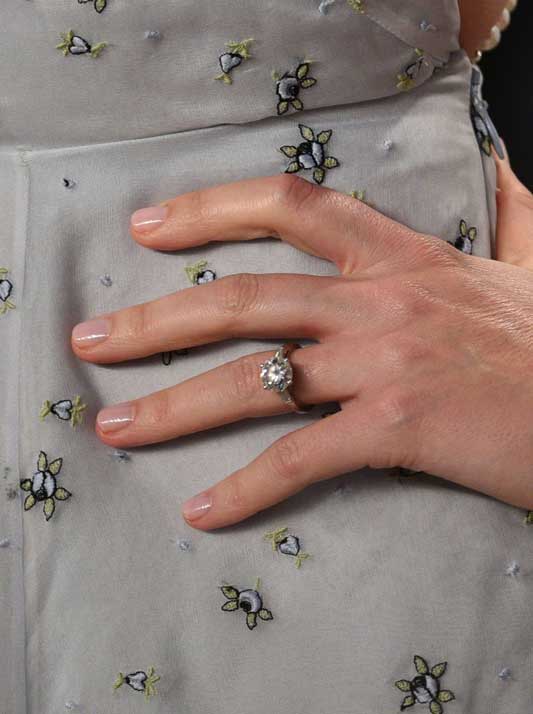
Are round diamonds more expensive?
Pricing always depends on the full picture: carat, cut grade, color, clarity (also known as the 4Cs of diamonds) and certification.
Where to spend:
Prioritize cut. In a round, light performance is everything.
Where you can be flexible:
Color and clarity may offer room to adjust, especially depending on the setting.
With rounds, you’re paying for precision. Make sure it shows.
The cut that sets the standard
The round brilliant cut remains the sparkle benchmark for a reason. It was engineered to do one thing exceptionally well: return light with consistency and impact. If you take one thing from this guide, let it be this. Prioritize the cut. Use the GIA cut grade as your simplest filter and aim for Excellent where possible. Then confirm what the report promises by viewing real videos or seeing the diamond in person. Light on paper is one thing. Light on your hand is another.
A circle has no beginning and no end. In a beautifully cut round brilliant, that continuity turns visible. Precision guides every facet; light moves cleanly through the diamond, and the sparkle feels effortless. More than a century on, it still sets the benchmark every time it catches the light.
Sources
- www.naturaldiamonds.com/engagement-rings/round-brilliant-cut/ ↩︎
- www.4cs.gia.edu/en-us/diamond-cut/ ↩︎
- www.4cs.gia.edu/en-us/diamond-cut/ ↩︎
- www.naturaldiamonds.com/engagement-rings/round-brilliant-cut/ ↩︎
- www.davidmorris.com/diamond-brilliance-explained-what-makes-a-stone-truly-shine/ ↩︎
- www.mcgowansjewellers.com/the-fire-of-a-diamond-what-is-it-and-why-is-it-important/ ↩︎
- www.caratbee.com/blogs/education/diamond-brilliance-all-you-need-to-know/ ↩︎
- www.diamondrensu.com/blogs/education/diamond-depth-and-table/ ↩︎
- www.ilacollection.com/blogs/news/what-are-the-ideal-proportions-for-a-round-brilliant-cut-/ ↩︎
- www.ilacollection.com/blogs/news/what-are-the-ideal-proportions-for-a-round-brilliant-cut-/ ↩︎
- www.ilacollection.com/blogs/news/what-are-the-ideal-proportions-for-a-round-brilliant-cut-/ ↩︎
- www.gemsociety.org/article/diamond-polish-symmetry/ ↩︎
- www.yadavjewelry.com/diamond-education/diamond-anatomy/diamond-depth/ ↩︎
- www.yadavjewelry.com/diamond-education/diamond-anatomy/diamond-depth/ ↩︎
- www.yadavjewelry.com/diamond-education/diamond-anatomy/diamond-table/ ↩︎
- www.4cs.gia.edu/en-us/diamond-cut/ ↩︎
- www.4cs.gia.edu/en-us/diamond-cut/ ↩︎
- www.vogue.com/article/engagement-ring-diamond-cut-style-meaning/ ↩︎
- www.vogue.com/article/engagement-ring-diamond-cut-style-meaning/ ↩︎


