
Picture a rough diamond fresh from the earth: heavy, opaque, unremarkable to most eyes. Now picture that same diamond after weeks in the hands of a skilled diamantaire, with facets ground to precise angles, light bending through it in every direction. That transformation, from raw crystallized carbon to something that seems almost to glow from within, is the art and science of diamond cutting. It’s a craft with roots in 14th-century Europe that today combines centuries of trained instinct with laser technology and 3D mapping1. And for anyone buying or collecting natural diamonds, understanding it is the difference between choosing a gem that truly lives and one that simply exists.
Why cut quality matters in natural diamonds
Of the 4Cs of diamonds — cut, color, clarity and carat — diamond cut is the only one entirely shaped by human hands. And it’s the most consequential.
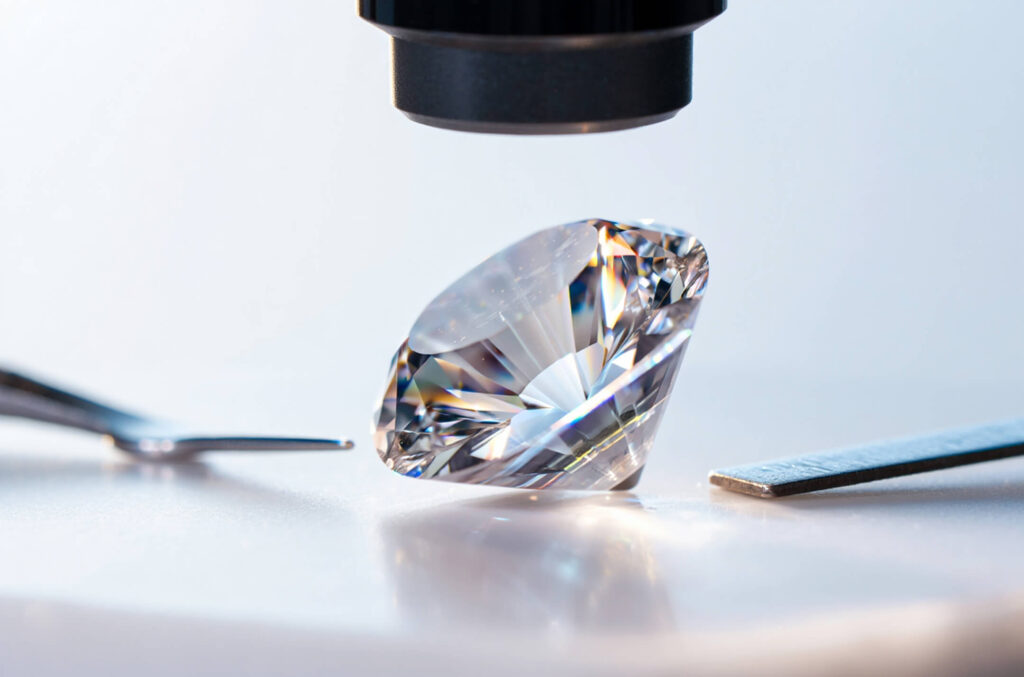
Cut quality determines how a natural diamond interacts with light: how it bends, reflects, and refracts every beam that hits it. This is what gives a diamond its fire (those flashes of spectral color), its brilliance (the white sparkle) and its scintillation (the dance of light as the gem moves). Cut is what makes a diamond look alive2.
Even a high-carat, near-flawless diamond can appear flat if its cut misses the mark. Conversely, a diamond with slightly lower grades in color or clarity can outshine competitors when the cut is exceptional3.
The diamond cutting process: step by step
Modern diamond cutting combines state-of-the-art technology with the trained eye of a skilled craftsperson4. Here’s how a rough diamond becomes a finished gem:
- Mapping: 3D scanning software analyzes each rough diamond’s shape, inclusions, and internal structure. Cutters use this data to model potential outcomes and determine how to maximize both yield and brilliance5.
- Sawing: Diamond-coated blades or, increasingly, high-precision lasers make the initial cuts, dividing the rough into workable pieces6.
- Cleaving / splitting: Larger rough diamonds may be split along their natural crystalline planes. This is a high-stakes step that requires expert knowledge of a diamond’s internal grain7.
- Bruting / shaping: Two diamonds are rotated against each other (or shaped mechanically) to round and refine the gem’s outline, establishing symmetry before faceting begins8.
- Polishing / faceting: Spinning wheels coated with diamond dust grind each facet to exact angles. This is the stage where fire, brilliance and scintillation are either achieved or lost9.
Throughout the process, the cutter (also called a diamantaire) makes dozens of precision decisions. How light performs in the finished gem depends on the sum of those choices.
The essentials of diamond cutting
Understanding diamond anatomy
Faceting is the process of cutting tiny flat surfaces into a diamond. The placement, size and angles of these facets (or flat surfaces) allow light to enter the gem, bounce around and shoot off it.
There are many different types of facets and terms regarding a diamond’s cut, which are useful to know when considering buying a diamond:
- Table: This refers to the large, flat top of a diamond. Size is important here. Too big and light leaks out, but too small and the gem’s sparkle output is reduced.
- Crown angle: This is the angle between the diamond’s table and the sloping facets just below it (called the crown facets). This affects how light enters and leaves the diamond, playing a key role in its dazzle.
- Pavilion depth: This is the lower half of the diamond. If it’s too shallow or too deep, light escapes instead of returning to your eye, making the diamond look dull or dark.
- Symmetry: A diamond’s symmetry is how precisely its facets are aligned, shaped and positioned next to each other. Even slight imperfections in positioning can cause diamond brilliance to dim. That could be why some diamonds might look a little ‘off’ to the naked eye.
Together, these elements help shape a diamond’s ‘light signature’. Two diamonds with identical carat weight and clarity can look totally different under the spotlight thanks to their cut.
How faceting and proportions affect brilliance
When Indian heiress Isha Ambani wore a 481.42 diamond carat masterpiece centered on an 80.73-carat cushion-cut diamond to the 2025 Met Gala10, no filters were needed. The gem’s precision-cut facets did all the work, commanding the room with a light performance that turned heads on one of fashion’s most watched stages.
That kind of impact is pure geometry. Each facet is positioned to bounce light exactly where it needs to go, creating the interplay of fire and brilliance that makes a well-cut diamond impossible to ignore.
Grading and evaluating rough diamonds
Before a cutter touches a rough diamond, they study it, using mapping technology alongside practiced intuition. They’re assessing:
- Natural shape and how it will inform the final cut.
- Internal inclusions and where they sit within the crystal.
- External blemishes that may need to be cut around or removed.
- Color distribution across the rough.
Potential yield, in other words, the usable weight that remains after cutting, expressed as a percentage of the original rough.
These decisions have long-term consequences. A well-evaluated rough diamond that is skillfully cut holds and grows its diamond value over time. A rushed or yield-driven approach can permanently compromise a gem’s brilliance — and its worth. Both diamond clarity and diamond color play into that evaluation from the very first assessment.
Cutting techniques and tools
Sawing and shaping
A diamond’s final form is decided before a single facet is cut. When a diamantaire picks up a rough diamond, they’re already reading it, looking at its grain, its fracture lines and the way inclusions sit within the crystal. That reading determines where the first saw cut lands.
Traditional blades coated with diamond dust were once the only option. Today, lasers handle the most demanding cuts; navigating internal grain patterns too complex or fragile to risk with a blade, following 3D-mapped paths with sub-millimeter precision11. The choice of method isn’t arbitrary, it’s a judgment call based on what the rough diamond will and won’t tolerate.
Bruting and polishing
Behind every remarkable diamond is a diamantaire who made dozens, sometimes hundreds, of small but consequential decisions. These carefully considered calls balance two competing priorities: preserving carat weight and maximizing brilliance.
Bruting gives the diamond its silhouette. Two diamonds are rotated against each other, or shaped using mechanical wheels, gradually rounding and refining the girdle until it meets the cutter’s exacting standard for symmetry. Get it wrong and the imbalance travels through every subsequent stage, affecting how light moves through the finished gem.
Polishing is the final reckoning. Rotating wheels coated with diamond dust grind each facet to precise angles, and those angles are everything. Too steep or too shallow and light leaks; exactly right and fire, brilliance, and scintillation all click into place. It’s where the numbers become something you can actually see. Diamond crafting at this level is as much instinct as it is technique12.
Laser cutting
Laser cutting doesn’t just improve on traditional methods. It makes certain cuts possible that simply weren’t before. High-powered lasers follow paths defined by 3D modeling software, working with tolerances measured in fractions of a millimeter. The results are faster and cleaner, producing less waste than blade cutting at comparable precision levels13.
But understanding what is diamond cutting at a craft level makes one thing clear: the technology is only as good as the cutter directing it. A laser running the wrong path is just a faster way to make the wrong cut.
How cut influences a diamond’s value
It makes sense that the more ravishing the diamond, the more coveted it is, and so a diamonds brilliance can be directly tied to its monetary value.
Polished natural diamonds larger than 0.3 carats (also known as 30 points) come with a diamond grading report. This document records the 4Cs of diamond grading, and in terms of cut, assigns a grade: Excellent, Very Good, Good, Fair, or Poor. It typically includes a diagram of the diamond’s exact proportions and measurementsxiv.
Diamonds graded Excellent command higher prices because brilliance is directly tied to beauty and desirability. Cut quality is also factored into resale and insurance assessments, making it one of the most financially consequential of the 4Cs. It’s also worth noting that cut interacts with the other Cs in ways that matter to long-term value: a well-cut gem makes the most of its clarity, which is part of why flawless diamonds occupy a category of their own when it comes to desirability and price14.
The difference between factory-cut and expertly-cut diamonds
Not all diamonds are cut with the same artistry. In some high-volume commercial operations, yield often takes priority over beauty. The goal is maximum carat weight from the rough, and cut quality can be sacrificed in the process.
The result is visible. Mass-market diamonds may look impressive under the bright fluorescent lights of a jewelry store but fall flat in natural daylight. Understanding what is lab grown diamond production makes this clearer: volume cutting and narrow quality ranges mean these gems rarely receive the individual attention a natural diamond does. Natural diamonds, by contrast, typically spend more time in a diamantaire’s hands, with choices made specifically for that gem.
Questions to ask when assessing diamond cut quality
If sparkle is top of your wish-list when buying or researching diamonds, keep these pointers front of mind:
Does it look symmetrical?
Uneven facets are often visible to the naked eye and almost always register in how the gem performs with light. A well-cut diamond shifts and flickers as its angles catch the light from different directions. A flat-looking gem in motion rarely improves when on the wrist or finger.
Ask to see the grading report
An Excellent — sometimes called “Ideal” — cut grade is the clearest signal of superior craftsmanship. When reviewing a grading report, look beyond the single cut grade to the full picture: proportions, symmetry and polish grades. A diamond can carry an Excellent cut grade overall while showing Very Good symmetry, which will affect its brilliance in subtle but real ways. Use the report as a starting point, not a final verdict.
Ask about light performance
Reputable sellers can provide light performance analysis — reports or visual tests that map how brilliance, fire, and scintillation behave in a specific gem. ASET (Angular Spectrum Evaluation Technology) imaging and Idealscope imagery are two tools commonly used to visualize light returnxvi. Ask for these where available. A gem that performs well on paper and under a performance scope rarely disappoints in person.
Trust your eyes
When a diamond catches your attention before you’ve even read the label, that’s usually the cut doing its job. While grading reports provide useful data, they don’t capture the experience of seeing a diamond move in light.
Cut quality and craftsmanship can outweigh carat size. A smaller diamond with an Excellent cut will often look more impressive — and hold its value better — than a larger gem with average proportions. When it’s time to choose, start with the cut.
It’s all in the cut
A natural diamond’s brilliance isn’t accidental. It’s the result of thousands of years of geological pressure and then weeks or months in the hands of someone who knows exactly how to coax light from raw crystallized carbon. Cut quality is where nature’s work and human skill converge, and for buyers, it’s the single most important factor to understand. A smaller, well-cut diamond will outshine a larger, poorly cut one every time. Start there, and everything else falls into place.
FAQs
A diamond’s carat weight tells you how large it is, but diamond cut quality determines how beautiful it looks. Well-cut proportions direct light through the gem with precision, generating fire, brilliance and scintillation, while a larger diamond with poor geometry can appear dull and lifeless regardless of its size. In terms of visual impact, a well-cut 1-carat diamond routinely outperforms a poorly cut 1.5-carat in side-by-side comparison. It’s a trade-off explored in depth when it comes to diamond carat and why cut so often wins.
Clarity measures the presence and extent of internal inclusions and external blemishes in a natural diamond. The GIA grades clarity on a scale from Flawless (FL) to Included (I3). Truly flawless diamonds, those with no inclusions visible even under 10x magnification, represent a tiny fraction of all diamonds mined. The rarity is geological: diamonds form under extreme pressure deep within the Earth, and the conditions that produce perfectly clear crystals are extraordinarily uncommon. For a closer look at what’s the highest clarity a natural diamond can achieve and what makes those gems so exceptional, the answer is more nuanced than most buyers expect.
The GIA grades colorless to near-colorless natural diamonds on a D-to-Z scale, where D represents a completely colorless gem and Z indicates visible yellow or brown tint. Colorless diamonds (D-F) are rare and command premium prices. Color grade also interacts with cut: a well-cut colorless diamond makes the most of its transparency, while even a lower-color gem can look striking when its facets are precisely arranged. Beyond the D-Z scale, fancy color diamonds occupy a category entirely their own, where intensity and saturation drive value rather than absence of color.
Diamonds have been associated with love and permanence for centuries, used in royal betrothal rings as far back as the 15th century. Their hardness, the highest of any natural material, made them a natural symbol of enduring bonds. That symbolism was culturally reinforced and globally popularized through the 20th century, and today a natural diamond engagement ring remains one of the most universally recognized gestures of commitment. The history of diamond engagement rings stretches further and runs deeper than most people realize.
When a high-profile engagement is announced, the ring often defines the conversation. From Princess Diana’s 12-carat oval sapphire, which reshaped demand for colored gemstone engagement rings, to the wave of emerald-cut and cushion-cut diamonds popularized by contemporary celebrities, public proposals have a measurable effect on consumer tastes. Buyers often look to aspirational figures when making their own choices, and the cuts and styles worn by icons tend to see spikes in demand. The most influential celebrity proposals reveal as much about shifting cultural values as they do about jewelry trends.
Sources
- www.capetowndiamondmuseum.org/education/history-of-diamond-cutting/ ↩︎
- www.4cs.gia.edu/en-us/blog/gia-diamond-cut-grade-six-things-to-know/ ↩︎
- www.4cs.gia.edu/en-us/blog/4cs-diamond-quality-most-important-c/ ↩︎
- www.gia.edu/doc/Modern-Diamond-Cutting-and-Polishing.pdf ↩︎
- www.cadjewelleryskills.com/jewellery-tech-blog-topics/jewellery-learning-resources/3d-diamond-scanners-work/ ↩︎
- www.gia.edu/doc/Modern-Diamond-Cutting-and-Polishing.pdf ↩︎
- www.rehsdiamonds.com/diamond-talk/f/the-art-of-diamond-faceting-and-cutting-techniques ↩︎
- www.langantiques.com/university/bruting/ ↩︎
- www.rehsdiamonds.com/diamond-talk/f/the-art-of-diamond-faceting-and-cutting-techniques/ ↩︎
- www.naturaldiamonds.com/culture-and-style/isha-ambani-met-gala-necklace/ ↩︎
- www.polisheddiamonds.co.nz/blog/diamond-education/diamond-cutting-process/ ↩︎
- www.capetowndiamondmuseum.org/about-diamonds/diamond-cutting-and-polishing/ ↩︎
- www.thediamondworks.co.za/diamond-services/diamond-cutting/ ↩︎
- www.brillianceindiamonds.com/blogs/the-diamond-diary/why-does-the-diamond-cut-affect-the-price/ ↩︎


