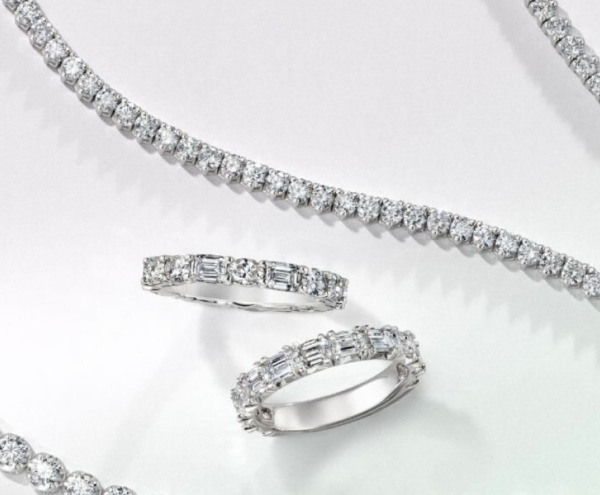

Most of us are used to seeing natural diamonds in their most dazzling form, turning heads on the red carpet or from the window of a jewelry store. But before they end up in bridal jewelry, chic tennis bracelets or a pair of earrings, a major transformation takes place – something which involves serious artistry and expertise.
Let us talk you through the process of diamond crafting – from recovery site to ring finger – so you can better understand how natural diamond jewelry is made…
What is diamond crafting?
Diamond crafting is the process of transforming a rough diamond (the form in which it emerges from the Earth) into a finished, polished gemstone ready to be set in fine jewelry. It is one of the most technically demanding disciplines in the world of precious materials, requiring a combination of scientific precision and deep artisanal knowledge.
The process moves through four essential stages: planning, cutting, shaping and polishing. Each one builds on the last, and a mistake at any point can compromise the entire gem. A natural rough diamond may be billions of years in the making, but it takes the expertise of a skilled craftsperson to unlock the brilliance held within it.
What makes diamond crafting distinct from working with other gemstones is the material itself. Diamonds are the hardest naturally occurring substance on Earth which means only another diamond can cut it. Every tool, technique and decision in the crafting process must account for that extraordinary hardness.
How natural diamonds are formed
A freshly unearthed natural diamond doesn’t immediately dazzle. Through a process of natural diamond formation, diamonds grow deep within the Earth’s mantle (typically 90 to 120 miles beneath the surface) under intense pressure and heat over the course of one to three billion years. At the point of recovery, a natural diamond is more of a rugged crystal than a sparkling gem. But inside every rough diamond lies the potential for brilliance, quite literally.

Key steps in diamond crafting
Cutting
Once a rough diamond has been assessed and planned, it passes to the cutter. This is the stage where potential becomes performance. The goal throughout is to maximize brilliance, symmetry and value while losing as little of the original rough as possible.
That’s the meticulous work of an expert diamond cutter or diamantaire.
Diamond cutting is both an art and a science. There are two main methods, and both aim to optimize light ‘return’ (how well a diamond reflects light) and sparkle.
The first method is handcrafted cutting, done by highly trained artisans using visual inspection and manual tools such as saws and cleavers. It’s the most traditional process, used long before automated machinery and computers.
The second is machine cutting, carried out using advanced lasers and scanning technology. This method is more common today, particularly in large-scale commercial operations (though expert technicians remain involved at key decision points).
Both approaches have their merits and understanding what diamond cutting is — and what each method means for a diamond’s final character — helps clarify why craftsmanship matters as much as technology.
Planning, sawing and shaping
Before a single cut is made, the rough diamond undergoes rigorous analysis. Even when a diamond is to be cut by hand, 3D imaging and mapping are used by specialists to digitally scan it ahead of any incisions. Advanced computer programs show cutters the optimal way to cut and shape the gem for maximum brilliance and minimal waste. This early stage is crucial: one wrong move could sacrifice carat weight, symmetry, or even the gem itself.
Next comes
- Cleaving or sawing: performed with lasers or phosphor-bronze blades coated with diamond dust. This separates the rough diamond into workable pieces.
- Bruting: the process of shaping a rough diamond into its initial, symmetrical outline (typically a round form) before the final facets are cut.
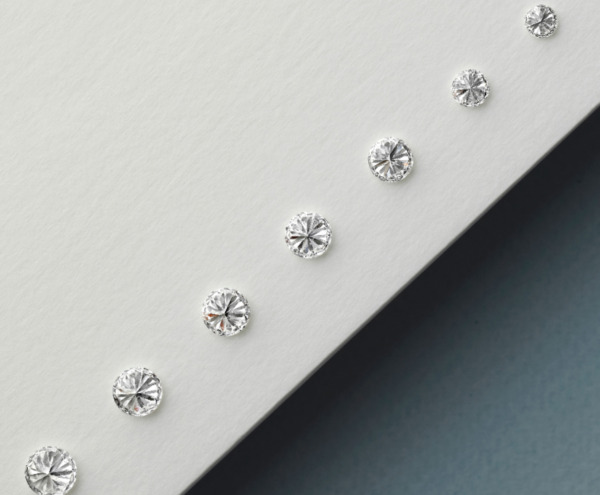
- Faceting: multiple tiny surfaces are added, allowing light to travel through the stone and create its signature sparkle. This is also when the diamond’s final shape (emerald, marquise or round for example) is fully defined. The quality of diamond cutting at this stage is what separates a good diamond from a truly brilliant one.
Polishing
While cutting does most of the legwork, polishing brings the finesse. The cut diamond is placed on a spinning wheel coated with diamond dust to gently refine and smooth each individual facet. It’s an incredibly painstaking process that can take days or weeks, depending on the size and complexity of the stone. With a diamond’s brilliance depending on it, every facet undergoes a final inspection.
Tools and technology used in diamond crafting
Modern diamond crafting draws on a combination of centuries-old techniques and highly advanced technology. The tools involved are as precise as the work they’re designed for.
- 3D mapping and scanning software: used in the planning stage to digitally model a rough diamond and calculate the optimal cut for maximum yield and brilliance. Programs can evaluate thousands of possible cuts in seconds.
- Laser cutting systems: high-precision lasers cleave and saw rough diamonds with accuracy that manual tools can’t always achieve, particularly useful for complex or unusually shaped roughs.
- Phosphor-bronze sawing blades: coated with diamond dust, these traditional blades are still used in handcrafted cutting for their control and tactile precision.
- Bruting machines: used to shape a diamond’s girdle (outer edge) into its round outline before faceting begins.
- Diamond-dust polishing wheels: the spinning Scaife, coated with a mixture of oil and diamond powder, is the final tool in the process — used to smooth and refine every facet to a mirror finish.
- Loupe and microscope inspection: throughout the process, craftspeople examine the diamond under magnification to verify symmetry, facet alignment and surface quality.
Even in the most automated facilities, skilled human judgment remains essential. Technology sets the parameters; the diamantaire makes the call.

Understanding diamond cut vs shape
Confused about the difference between diamond cut and shape?
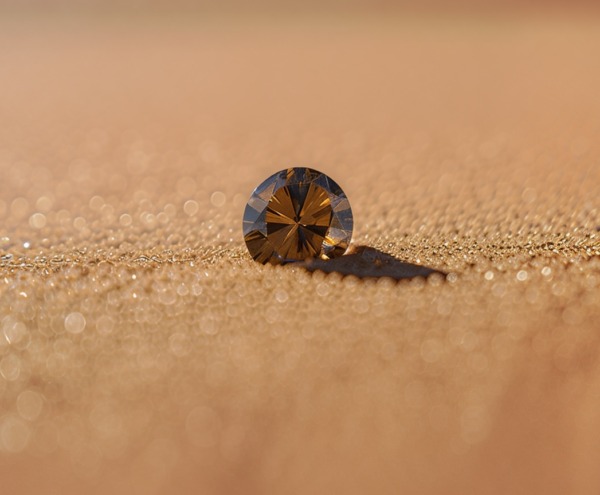
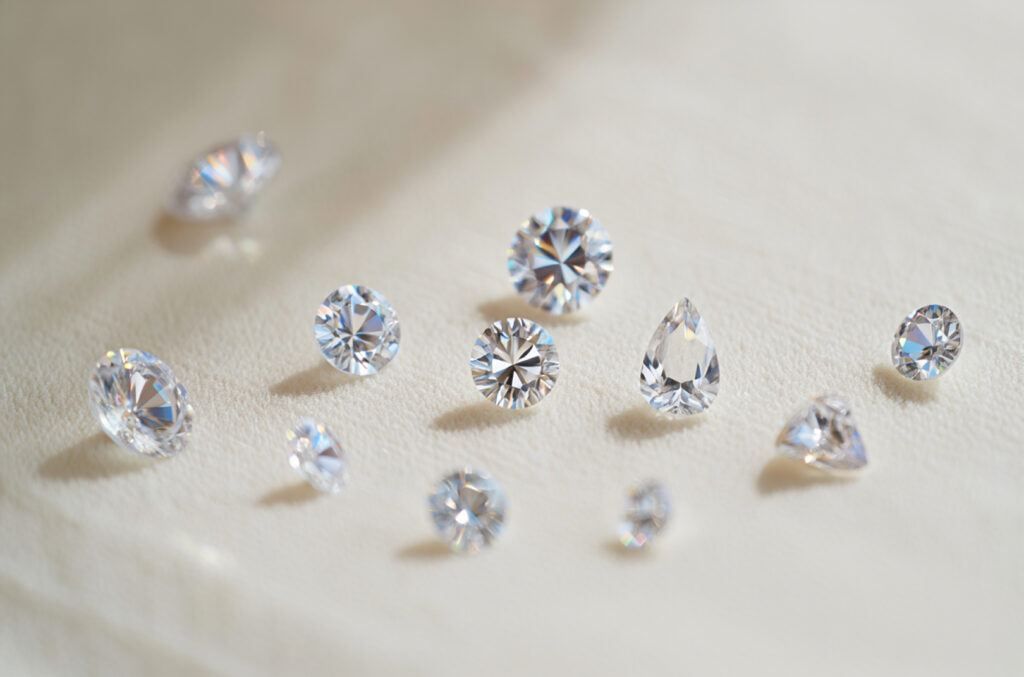
Diamond cut refers to the facet arrangement and how light interacts with the diamond to create brilliance (sparkle) and fire (flashes of rainbow color). Different diamond cuts have different amounts of facets and are used for different shapes. The brilliant cut, probably the most popular in recent times, is characterized by its high number of facets (usually 57 or 58).
Diamond shape is its outline or ‘silhouette’, such as a heart, emerald, oval, marquise or round, for example.
Cut quality is one of the most important factors in a diamond’s final value. Understanding how diamond carat relates to cut helps clarify why a well-crafted smaller stone can outshine a larger one with a mediocre cut.
When buying a diamond, choosing between diamond shapes can be harder than it looks. Always try on pieces before buying, if possible, so you can see how different shapes suit you.

Appreciating the journey behind every diamond
Now that you understand the process that turns a rough diamond into a glorious, glittering gem, you might find yourself even more appreciative of the extraordinary craft that went into your favorite fine jewelry pieces. Billions of years of geological formation, then months of meticulous human expertise — all to produce something worn in life’s most memorable moments and carried forward for a lifetime.
Knowing the journey your diamond has been on makes it much more than just a beautiful piece of jewelry. And that sense of meaning doesn’t diminish over time, it’s part of why natural diamonds hold value in ways that go well beyond their price.
FAQs
How do the 4Cs affect diamond craftsmanship?
Directly, and at every stage. The 4Cs of diamonds (cut, color, clarity and carat) aren’t just grading criteria, they’re the variables a craftsperson works around from the moment a rough diamond arrives in the workshop. Cut is the most directly influenced by craftsmanship. It’s entirely a product of human decision-making and skill. Clarity determines which parts of the rough can be preserved and which must be sacrificed to avoid visible inclusions. Color influences which parts of the stone are prioritized during faceting, since some areas of a rough diamond may carry stronger or weaker color. And carat is the constant tension in every cut, deciding whether to maximize brilliance or preserve weight. Getting that balance right is the central judgment call of the entire process.
How important is diamond clarity in the crafting process?
It shapes every major decision. Before any cutting begins, the craftsperson studies the rough diamond’s inclusion map. This shows the location, size and nature of internal characteristics that affect both appearance and structural integrity. Inclusions near the surface may be removed entirely during cutting; those deep within the stone may be positioned beneath a facet junction where they’re least visible. The goal is to make the finished diamond as visually clean as possible without sacrificing more carat weight than necessaryvii. Understanding a diamond clarity guide helps buyers appreciate why two diamonds of the same carat weight can look and behave very differently once cut.
How does carat weight impact crafting and pricing?
More than most buyers expect. Larger rough diamonds are exponentially rarer than smaller ones, which is why diamond size and value don’t scale in a straight line: a 2-carat diamond is not simply twice the price of a 1-carat. In crafting terms, a larger stone demands even greater precision. Any error in planning or cutting that costs carat weight on a 3-carat rough has a far greater financial impact than the same mistake on a smaller stone. Polishing decisions are similarly high-stakes: each pass of the wheel removes materialviii. The entire process is a negotiation between achieving ideal proportions and preserving as much of the original diamond as possible. That tension is what makes large, well-cut natural diamonds so rare and so valuable.
Sources
- www.capetowndiamondmuseum.org/about-diamonds/formation-of-diamonds/ ↩︎
- www.caratx.com/blog-post/the-journey-of-a-diamond-from-rough-stone-to-finished-brilliance ↩︎
- www.naturaldiamonds.com/historic-diamonds/diamond-cutting-history/ ↩︎
- www.capetowndiamondmuseum.org/about-diamonds/diamond-cutting-and-polishing ↩︎
- www.britannica.com/art/diamond-cutting ↩︎


