
Answer
The value of a natural diamond extends beyond its price. While rarity, the 4Cs and certification contribute to its financial value, natural diamonds also carry lasting emotional value through the memories, milestones and family history they represent. Together, these qualities make a natural diamond both a financial asset and a meaningful heirloom.
Key takeaways
A natural diamond’s value combines financial and emotional significance.
Rarity, the 4Cs and certification influence financial value.
Exceptional rarity supports long-term financial value.
Personal stories and family history contribute to lasting emotional value.
Certification and proper care can help protect a diamond’s long-term value.
Natural diamonds are one of the few things in life that seem to transcend both time and trend. They’ve been prized for thousands of years, and today they remain as sought-after and culturally significant as ever. But do natural diamonds hold value? It’s a question worth asking. Whether you’re buying a diamond for love, legacy or long-term value, here’s what you need to know.
Does diamond value increase over time?
Financially speaking, while no one can predict the future, natural diamonds have generally held their value over the years. Historical data shows that the average price of a 1-carat round brilliant diamond has appreciated significantly over the past five decades, increasing more than tenfold since 1960, with premium D-color stones now exceeding $20,000.
That said, not all diamonds appreciate equally. The factors that matter most are familiar: rarity, size, quality and color. A natural diamond that rates highly across the 4Cs (particularly at higher carat weights or with fancy color) has historically been far more likely to retain or increase in value than a smaller, lower-grade gem. According to the Fancy Color Research Foundation, pink diamonds have appreciated by 393.5% and blue diamonds by 242.4% since 2005. This trajectory is driven partly by the 2020 closure of Australia’s Argyle Mine, which supplied over 90% of the world’s pink diamonds. Colorless diamonds of exceptional quality have moved more modestly but consistently.

The emotional vs. financial value of diamonds
A natural diamond becomes part of a family’s history, especially when passed down through generations. With each new chapter it sees, it becomes even more cherished and loved in ways that no price tag can quantify.
On a less grand timescale, natural diamond jewelry has a day-to-day emotional return, too. There’s a reason why diamonds are used for engagement rings. It’s the flash of joy as you slip it onto your finger in the morning, remembering the moment you said yes. The connection to your grandmother as you fasten the clasp to her treasured pendant, passed down first to your mother, and now you. Or the sense of pride you feel stepping out in the diamond studs you bought yourself for nailing that promotion, or just for making it another year around the sun.
The financial and emotional dimensions of a diamond’s value aren’t always easy to separate and perhaps they don’t need to be. A ring inherited from a grandmother may be worth $8,000 at auction and yet completely priceless to the person wearing it. A diamond bought to mark a personal milestone carries a memory that appreciates independently of any market.
How natural diamonds came to represent love and commitment
Did you know the earliest recorded diamonds date back over 2,500 years to India? There, they were collected from rivers and cherished for their mystical properties and unmatched hardness (diamonds are the hardest naturally occurring substance on Earth).
But these early diamonds weren’t beautifully cut or polished like those we pore over today. Their raw, natural form (known as rough diamonds) has sometimes been compared to quartz or other rough stones, though they were still striking enough to become covetable symbols of luck and love, even back then.
By the 13th century, diamonds began appearing in European royal jewels, often set into religious relics or ornate coronation regalia. As trade routes expanded, they made their way from India to the courts of Europe, where they quickly became seen as rare and powerful treasures.
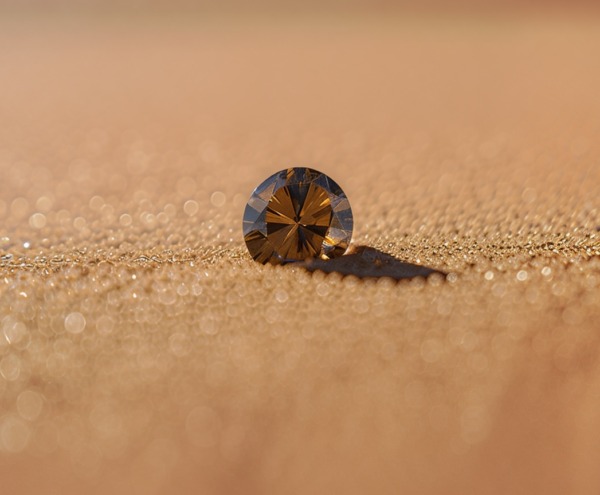
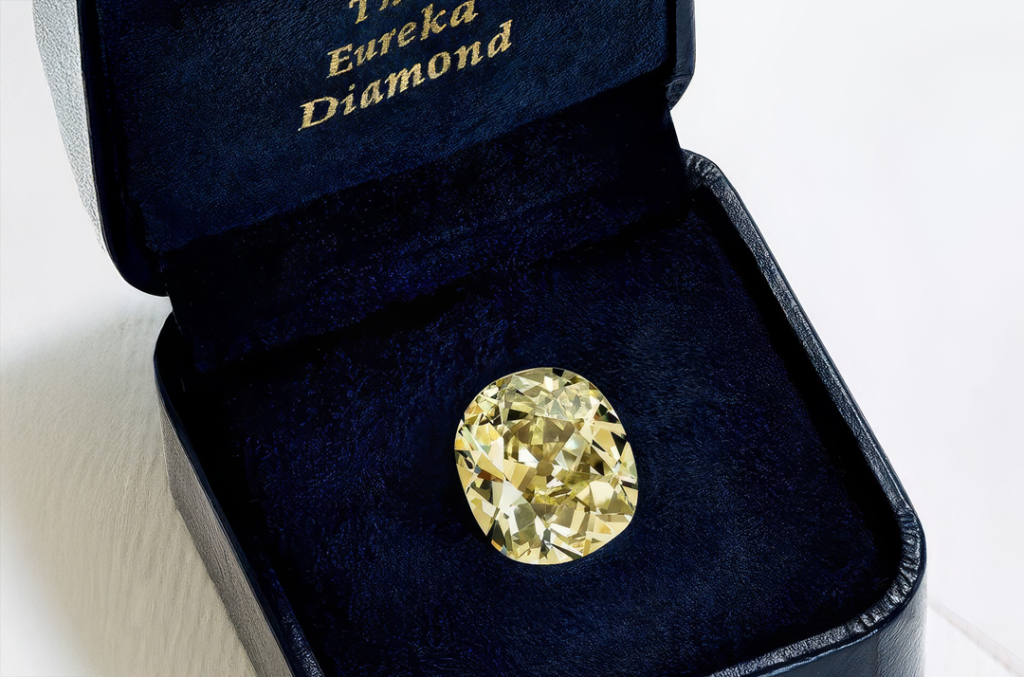
Then came South Africa’s diamond discovery in the 1800s. The Eureka Diamond (pictured below), a 21.25-carat brown-yellow diamond, was found in 1867 by 15-year-old Erasmus Stephanus Jacobs near Hopetown, a farming town that faces onto the mighty Orange River. This landmark moment dramatically changed the accessibility and supply of natural diamonds forever.
Fast-forward to the 20th century and diamonds began to represent something else – love, longevity and complete devotion. A natural diamond engagement ring became central to pretty much every wedding proposal.
Today, diamond jewelry fits every occasion and celebration, though still just as sought-after and precious. From coming-of-age gifts to graduation celebrations, personal milestones and wedding jewelry, diamonds continue to symbolize true love and commitment – whether it’s to yourself or someone else.
Natural diamonds are wearable memories, carrying a mood and sentiment of their own. But monetary value aside – and arguably more importantly – diamonds can hold serious emotional currency. Natural diamonds are gifted during life’s most intimate and transformative moments: proposals, births, special achievements and emotional farewells.
And as anyone who’s been lucky enough to receive one will tell you, the real value of a diamond is as much about the story behind it as it is about its 4Cs grading. Royal and celebrity diamonds have always amplified this cultural weight. The engagement diamonds of royalty — from the sapphire-and-diamond ring of Princess Diana to the extraordinary celebrity proposals that have shaped what the world considers romantic — consistently demonstrate that a diamond’s meaning extends far beyond its monetary value. These gems don’t just hold financial worth; they hold cultural memory.
The same is true on a more personal scale. Bridal jewelry chosen for a wedding day becomes part of a family’s visual vocabulary. It’s the ring in every photograph, passed forward as a physical record of love.

Factors that influence diamond value
The 4Cs
The 4Cs of diamonds refer to cut, color, clarity and carat weight. Together, these four factors determine a diamond’s brilliance, beauty and rarity. While it’s not always quite as straightforward as this, generally a diamond that scores highly across all four Cs is exponentially more valuable than one that doesn’t.
- Cut is widely considered the most important of the four. A well-cut diamond reflects light efficiently, maximizing brilliance and fire regardless of its other grades. For value retention, cut quality matters enormously: an Excellent or Ideal cut grade from a recognized lab (like the GIA or AGS) is a strong long-term signal.
- Color operates on the GIA’s D-to-Z scale for colorless diamonds. D, E and F grades command the highest premiums for traditional white diamonds. Fancy colored diamonds (vivid pinks, blues, greens) operate on a separate scale and can command extraordinary premiums at the Fancy Vivid level.
- Clarity measures the presence of inclusions and blemishes. For value retention, Flawless (FL) and Internally Flawless (IF) grades carry the greatest long-term prestige, though VS1 and VS2 grades offer strong visual quality at a more accessible price point.
- Carat weight is the most immediately visible factor in pricing. Value doesn’t scale linearly: a 2-carat diamond of equivalent quality is worth more than twice a 1-carat, because larger stones are exponentially rarer. For investment-minded buyers, stones at or above key threshold weights (1ct, 2ct, 3ct) tend to command stronger premiums.
Certification matters as much as the grades themselves. GIA (Gemological Institute of America) and AGS (American Gem Society) are the most rigorous and widely recognized grading labs. A diamond without a GIA or AGS certificate is significantly harder to sell at fair value, regardless of its quality.
Rarity
Put simply, natural diamonds are precious because they’re incredibly rare, especially ones that are good enough quality to wear. Formed under immense pressure and heat deep within the Earth, each diamond takes billions of years to materialize. Transported further to the surface by volcanic eruptions, only a fraction of diamonds are accessible to humans and fewer still are of good enough quality to be made into jewelry.
Real diamond specimens are completely unique. Much like a snowflake, they each have their own set of characteristics, making each one truly one-of-a-kind. You’ll never find two natural diamonds the same.
Rarity drives financial value in measurable ways. A flawless, colorless diamond above 5 carats is not simply a larger version of a 1-carat stone, it is a categorically rarer object, and its price reflects that. The Pink Star, a 59.60-carat Fancy Vivid pink, sold for $71.2 million at Sotheby’s in 2017; the Oppenheimer Blue, a 14.62-carat Fancy Vivid blue, fetched $57.5 million at Christie’s the previous year. These are extreme examples, but they illustrate a consistent principle: exceptional rarity commands exceptional value.

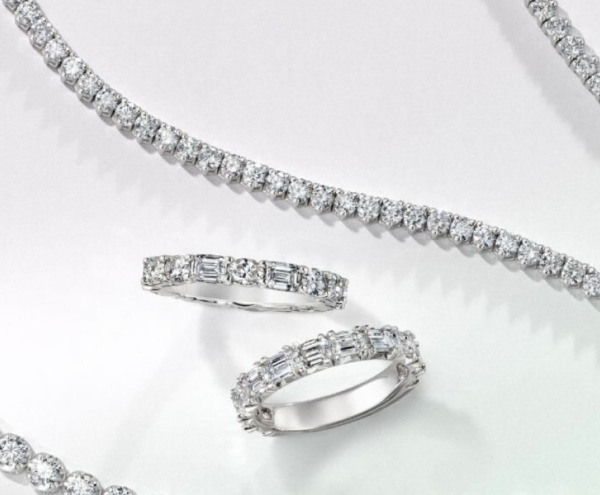
Image courtesy from Margalitrings

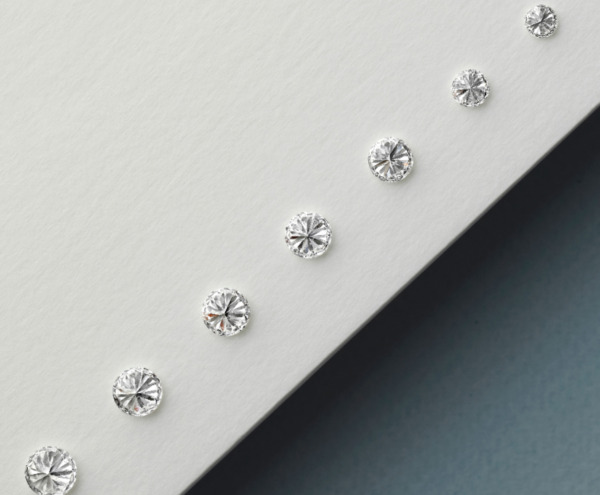
Image courtesy from Margalitrings
How to protect diamond value
Owning a natural diamond of quality is one thing; protecting its value over time requires a few deliberate steps.
- Get it certified and keep the paperwork. A GIA or AGS certificate is the single most important document your diamond can have. Store it securely and keep it with the diamond wherever it goes (whether you’re insuring, reselling, or passing it to a loved one).
- Insure it properly. Standard household insurance rarely covers the full replacement value of fine jewelry. A specialist jewelry insurance policy, updated with a current appraisal every three to five years, ensures your diamond is protected against loss, theft or damage at its actual market value.
- Appraise regularly. Diamond values shift with markets. An appraisal from a certified gemologist every few years keeps your insurance coverage current and gives you an accurate picture of what your diamond is worth today.
- Store it properly. Despite being the hardest natural substance on Earth, diamonds can scratch other jewelry and be scratched by other diamonds. Store pieces individually in soft pouches or a lined jewelry box.
- Clean it with care. Regular cleaning maintains brilliance and lets you spot any loose settings early. A soft brush, warm water and mild dish soap works for most diamonds at home.
- Be strategic about resale. If the time comes to sell, the route matters. Reputable auction houses (Christie’s, Sotheby’s, Bonhams) achieve the strongest prices for significant pieces. Certified diamond dealers and specialist marketplaces are appropriate for mid-range gems. Avoid uncertified sales, pawnshops, or platforms without buyer protection for anything of value.
For anyone thinking about building a longer-term diamond jewelry collection, understanding which pieces hold value and which are primarily ornamental is the essential starting point.
Natural vs lab-grown diamonds: which tell a richer story?
Tempted by a lab-grown diamond? The affordability is real and the visual similarity is genuinely hard to argue with. But a natural diamond carries something a controlled environment can’t produce: a history. Every inclusion, color quirk and structural characteristic is a record of specific conditions that existed billions of years ago, deep within the Earth which will never be repeated.
Understanding diamond cutting adds another layer. The skill and judgment required to transform a rough natural diamond into a finished gem (preserving its character while unlocking its brilliance) is itself a form of authorship. A lab-grown diamond is grown to specification; a natural diamond is interpreted by a craftsperson who works with what billions of years produced. That difference is felt, even if it can’t always be articulated.
A diamond’s real value is defined by love, not labels
As most of us can probably agree, the value of something isn’t down to the amount of money we pay for it, but what it’s worth to us personally. It’s the same with diamonds – everyone’s idea of a ‘priceless’ item will be different. The real value of a natural diamond isn’t just in its rarity, sparkle or brilliance, but its meaning and the story you want it to tell – which, if you ask us, is one of the most valuable gifts of all.
FAQs
Do natural diamonds retain value?
Natural diamonds (opens in a new window) have historically retained value because of their rarity and finite supply. While resale prices vary, natural diamonds have appreciated by an average of 2-3% per year over the past 50 years.
How important are the 4Cs when reselling a natural diamond?
The 4Cs of diamonds (opens in a new window) play a significant role in resale value. Diamonds with higher grades for cut, color, clarity and carat are generally more desirable to buyers.
Are larger diamonds easier to resell?
Larger natural diamonds are generally more valuable because they are rarer. When considering resale, it’s also helpful to understand diamond cut vs shape (opens in a new window), as cut quality has a greater influence on value than shape alone.
How does rarity impact resale value?
Rarity is one of the biggest influences on diamond value (opens in a new window). Exceptional natural diamonds, including larger gems and rare colors, have historically been more likely to command premium prices.
How do the 4Cs and certification affect resale value?
The 4Cs and an independent grading report help buyers assess a diamond’s quality and authenticity. Both are important considerations when investing in diamonds long term (opens in a new window).
How do natural diamonds perform on resale?
Real diamonds (opens in a new window) have historically retained value because of their rarity and finite supply. Resale prices vary depending on the 4Cs, certification and market demand, but natural diamonds have outperformed lab-grown diamonds.
Does certification influence resale value?
Certification provides independent verification of a diamond’s quality, making diamond jewelry easier for buyers to assess and compare on the resale market.
Does provenance or history affect value?
A diamond’s provenance and ownership history can contribute to its appeal. Antique diamond styles (opens in a new window) may also appeal to collectors and buyers looking for distinctive designs.
Sources
- www.ajediam.com/diamond-prices/historical-diamond-prices/ ↩︎
- www.fcresearch.org/press-releases/ ↩︎
- www.naturaldiamonds.com/science-of-diamonds/the-closure-of-the-worlds-main-pink-diamond-source/ ↩︎
- www.naturaldiamonds.com/historic-diamonds/ctf-pink-star-diamond/ ↩︎
- www.gia.edu/gia-news-research/spring-2016-auction-update-big-checks-mega-diamonds ↩︎
- Natural Diamond Council. Diamond Value: What Affects Resale Prices. https://www.naturaldiamonds.com/diamond-jewelry/diamond-value/. Date accessed: 24 July 2026. ↩︎
- Gemological Institute of America (GIA). The Transformation of Diamond Cut Quality Grading. https://www.gia.edu/gia-news-research/transformation-diamond-cut-quality-grading. Date accessed: 24 July 2026. ↩︎
- Natural Diamond Council. Diamond Value: What Affects Resale Prices. https://www.naturaldiamonds.com/diamond-jewelry/diamond-value/. Date accessed: 24 July 2026. ↩︎


