
Diamond cuts sit at the centre of how a stone’s beauty is experienced. Within the framework of the 4Cs of diamonds – cut, colour, clarity and carat, cut is the factor most responsible for how brilliantly a diamond reflects light. When the princess cut emerged, it disrupted the round-cut reign. With its clean angles and high-wattage sparkle, it marked a shift, evolving from the French Cut in the 1960s into something sharper and more modern.
By the 1980s, it had claimed its name and its following. This dynamic era was characterized by a new cultural ethos focused on self-gratification and dressing to convey power and success, inspired by figures such as Nancy Raegan and Princess Diana. And the princess cut fit the mood: striking and unapologetically bold. It still feels that way today. It catches light like a hall of mirrors and sits beautifully in a wide range of settings.
If you’re hesitating between a princess cut vs cushion cut, figuring out the ideal length-to-width ratio, deciding between a prong vs bezel setting, or trying to decode princess cut diamond price and diamond color, you’re in the right place.
What is a princess cut diamond?
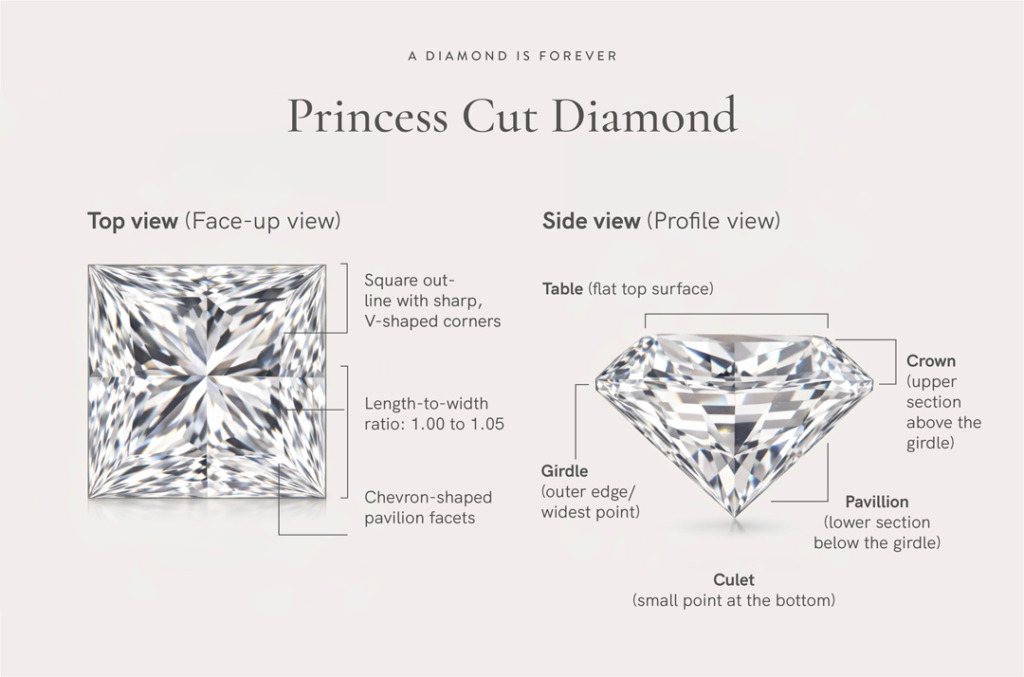
A princess cut diamond is a square or slightly rectangular gem with sharp corners and facets designed to reflect as much light as possible. The cut first emerged in the 1960s and was refined in the 1970s by diamond cutters Betzalel Ambar and Israel Itzkowitz and marked a pivotal moment in modern diamond cutting, engineered to retain more of the rough than a round brilliant1.
Its proportions make it one of the more cost-effective shapes per diamond carat, which suits everything from pared-back solitaires to sculptural halos; one of the reasons it remains a modern favorite2.
Princess cut diamond shape: key characteristics that affect sparkle
Faceting and brilliance
When it comes to sparkle, princess cut engagement rings often go head-to-head with round brilliants, and for good reason. While the shape is sharper, the faceting style delivers that same crisp, high-energy flash people love.
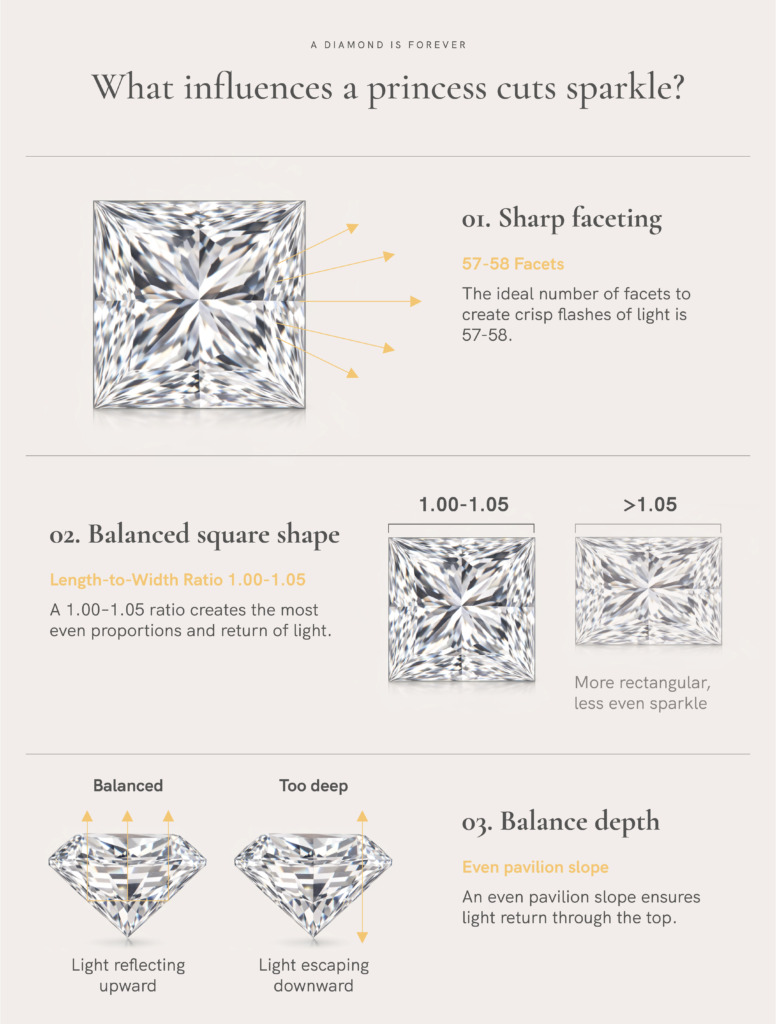
Most princess cut diamonds have 57 or 58 facets, crafted in a way that maximizes light reflection through the crown. It’s less of a soft glow and more of a swift flash of glitter, the kind that catches the light whenever you move your hand. Some modified versions play with the facet layout, but the classic four-sided pyramid structure remains the go-to for brilliance and balance.
ADIF tip: If sparkle is your non-negotiable, make sure your diamond is well cut; even slight variations in proportions can dull that fire3. For a princess cut, aim for a truly square outline with a 1.00 to 1.05 length-to-width ratio, crisp facet symmetry and a pavilion that slopes gently without bulging. It should look balanced and bright face-up, with no excess weight hiding beneath the surface4.
Length-to-width ratio
When choosing a princess cut diamond, proportion makes a subtle but noticeable difference. For a classic square look, the sweet spot is usually a length-to-width ratio between 1.00 and 1.05; anything beyond that, and you’ll start to see a more rectangular silhouette5.
If you’re wondering what size for an engagement ring is best, the answer depends on the look that resonates with you the most. Some prefer the crisp symmetry of a perfect square, while others lean toward a slightly elongated finish.
Symmetry matters too. When viewed from above, the facets should align cleanly across both axes, left to right, top to bottom. Flip the diamond over, and the shape should still feel balanced and mirrored6.
Corner vulnerability and protection
The pointed corners of a princess cut diamond are part of its appeal; they give the shape its sharp, architectural edge. But they’re also the most delicate part of the design.
As the corners come to a fine point, they’re more exposed to knocks and snags, which means they’re at a higher risk of chipping over time. While it’s not a dealbreaker, it does make setting choice especially important.
To keep your diamond secure, look for protective details like box claws that cradle the corners, or settings that wrap around the edge, such as a bezel or halo setting7.
Princess cut vs cushion cut: what’s the difference?
Sharp modern vs soft pillow shape
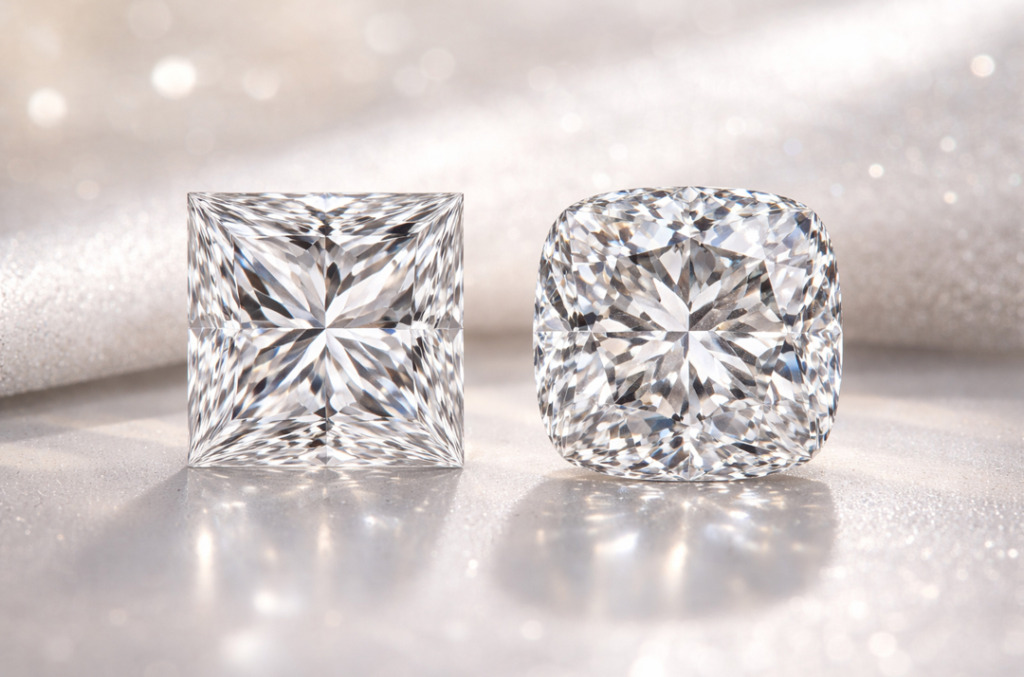
The princess cut and cushion cut may seem similar at first glance, but their shapes tell very different stories.
The princess cut: modern lines, sharp sparkle
A princess cut diamond is defined by its sharp corners and straight edges, a silhouette that feels distinctly modern. It suits those drawn to precision, symmetry and bold lines. There’s nothing soft about it, and that’s part of its appeal8.
The cushion cut: soft shape, romantic shine
The cushion cut, by contrast, is all about curve and softness. Its rounded corners and pillow-like outline create a more romantic feel. It’s often associated with vintage jewelry but it works just as well in modern settings9.
How to choose
Visually, princess cut diamonds appear more structured, while cushion cuts offer a gentler, more fluid shape. Both are versatile and popular for engagement rings; the difference is in the mood they create. The best way to decide? Try them on in natural light and opt for the one that connects with you the most.
Crisp scintillation vs broader ‘chunky’ flashes
The princess cut: sparkle with structure
With its chevron-shaped pavilion facets, the princess cut delivers a sharp, high-energy glitter. Fewer facets are like a spotlight moment with bold, graphic flashes. Add more (three or four chevrons), and the sparkle becomes faster and finer, like strobe lighting10.
The cushion cut: all glow, no edge
The cushion cut takes a softer approach. Its larger facets disperse light more broadly, giving off a romantic, rainbow-hued fire. Classic cushions offer balanced brilliance, while modified cushion cuts introduce extra facets that create that coveted crushed ice effect, a blur of shimmer rather than a single flash11.
Value and hiding inclusions
Princess cut: brilliance hides a lot
Thanks to its intricate facet pattern and high brilliance, the princess cut can disguise minor inclusions surprisingly well, even at lower clarity grades12.
Cushion cut: clarity counts more
The cushion cut, with its broader, open facets, tends to reveal more inclusions. That’s why many shoppers lean toward stones graded SI1 or higher on the GIA clarity scale for a cleaner look.
Modified cushion cuts with a crushed ice effect can help mask imperfections but classic cushions are typically less forgiving when it comes to clarity13.
Choosing a princess cut engagement ring setting (prong vs bezel)
The pointed corners of a princess cut need the right setting to stay secure, stylish and damage-free for the long haul.
Prong setting
The four-prong setting is classic with minimal metal and maximum light. For princess-cut diamonds, V-prongs are key, cradling each corner and adding protection without interrupting the shape.
Want to make the prongs feel invisible? Baylee Zwart, founder of LA fine jewelry label AZLEE, suggests a subtle two-tone trick: “If doing a prong setting, I do love the concept of doing the band of the engagement ring in yellow gold, with the basket and prongs in white gold or platinum, so that the stone has a floating effect and the prongs disappear.”14
ADIF tip: Prongs can bend, wear down or even snap. Get them professionally checked at your jewelers twice a year, especially on an engagement ring you wear daily15.
Bezel setting
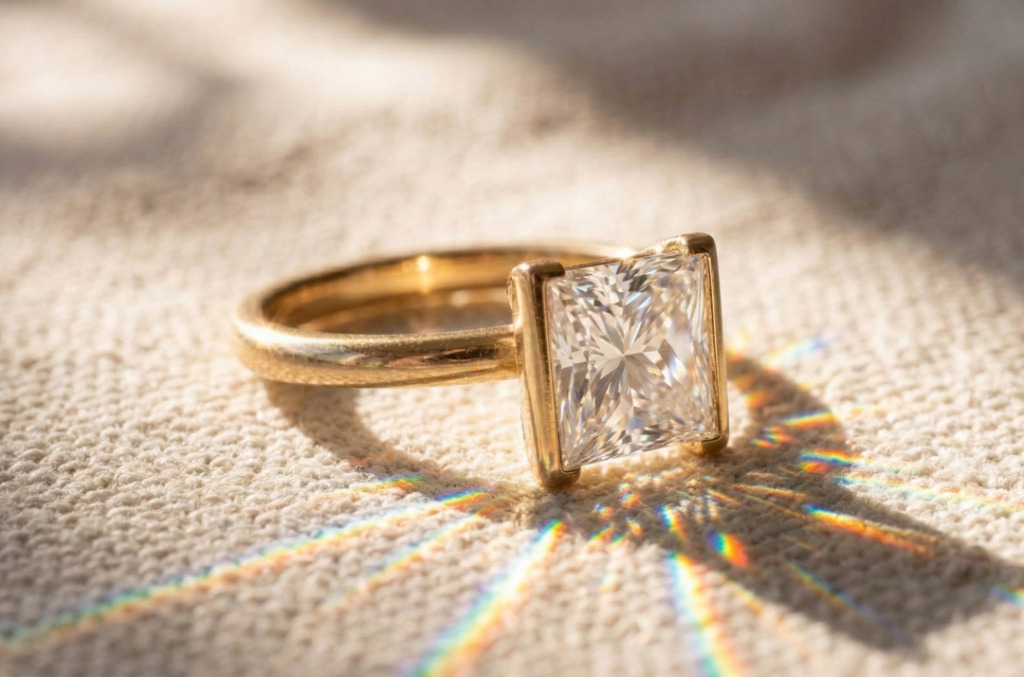
The bezel setting frames the diamond in a metal rim, equal parts style and protection. A full bezel offers complete coverage with a modern, sculptural edge. A half bezel leaves the corners exposed, striking a balance between brilliance and security16.
Zwart often opts for this setting because it cleanly frames the shape of the diamond. “To me, it feels complete and beautiful without anything else added or needed,” she says, proof that a strong silhouette can speak for itself.
Which works best?
- If you’ll be wearing your ring at the gym, for school runs, or throughout the working day, a bezel setting offers practical protection, especially when it comes to the pointed corners on a princess cut.
- If maximum sparkle is the goal, prongs keep the metal to a minimum, and the brilliance dialed up.
- If you’re drawn to something surprising yet functional, a half bezel gives you protection and edge: a modern choice with a strong silhouette.
Style spotlight
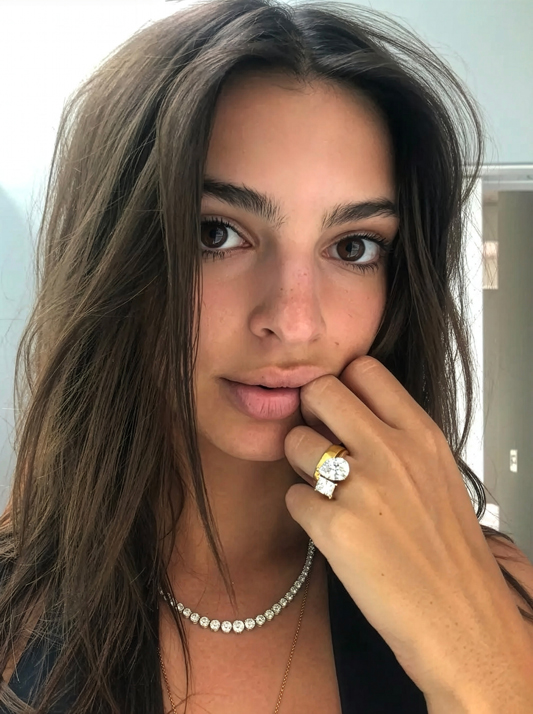
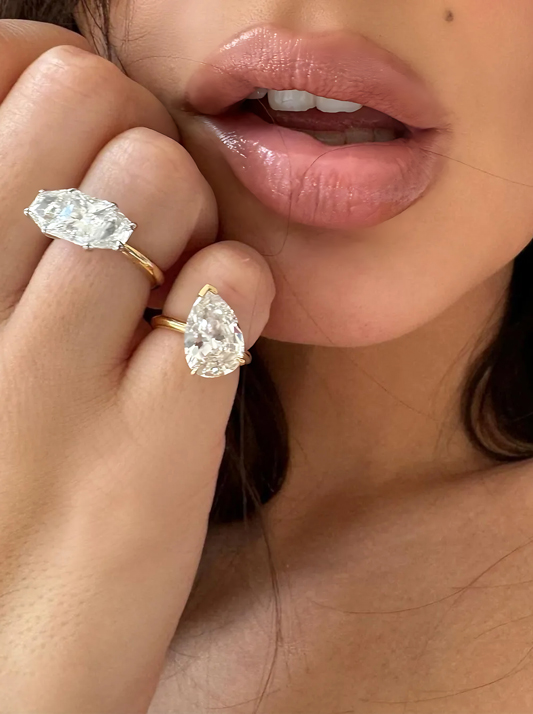
Emily Ratajkowski’s princess-cut engagement ring was anything but traditional, a toi et moi design paired with a pear-shaped diamond. After her split, she had the original ring, which comprised a princess-cut and a pear-cut diamond, reset into two ‘divorce rings’ by ring designer Alison Chemla of Alison Lou, one featuring the original princess cut flanked by trapezoid side stones in a bold trilogy setting, and the other featuring the pear-cut diamond. It’s a striking example of how the princess cut can move between romance and reinvention, all via a strong setting choice.
Princess cut diamond price: what drives cost and value?
Princess cuts often cost 25 to 35% less per carat than round brilliants, not due to brilliance, but because they retain more of the rough. As explored in our historic guide to the value of natural diamonds, that efficiency translates into better diamond value and more visible carat for the spend.17.
What affects price
Carat
Princess cuts often look bigger than they weigh. Their square shape and large table give you a more visible surface than a round diamond of the same carat. This is ideal if you want to create an impact without the extra cost. Just keep an eye on key price jumps at milestone weights and aim for a balanced length-to-width ratio between 1.00 and 1.05 for the cleanest silhouette18.
Cut
Cut quality is everything; it has the biggest impact on brilliance as well as being a major price driver. A well-cut princess diamond looks brighter and can help disguise inclusions19. This is where it pays to invest.
Color & clarity
Because princess cuts tend to hide inclusions well, clarity grades such as SI1 or VS2 offer a clean appearance at a more accessible price point20.
Princess cuts tend to show a little more warmth than round brilliants, especially at the corners. If you’re aiming for a bright, white look, start your search around H color and adjust from there or lean into the color with a Desert diamond, depending on your setting and priorities21.
Princess-cut diamond color: what to choose for a bright look
In white metals, go cooler
For platinum or white gold, D to H color grades keep the diamond looking bright and white. As princess cuts retain more color, a slightly higher grade helps maintain a clean, crisp appearance22.
In yellow or rose gold, go warmer
Warm metals soften visible color, so you can choose a G to J grade and still get a beautiful result. It’s a clever way to get more carats for the spend23.
Color or clarity?
If your diamond is front and centered in a white-metal solitaire, make sure to prioritize color. In yellow gold or detailed vintage-style diamond jewelry, you can shift focus to cut and diamond clarity instead.
Structure, sparkle and staying power
The princess cut is structured, bold and effortlessly elegant, a shape that holds its own without shouting. But brilliance needs support: those pointed corners should always be protected, whether with prongs or a refined bezel.
It’s also quietly clever. Princess cuts often deliver more visible carat for less than round cuts, though they do show more warmth. The fix? Choose a color grade that works with your metal, cooler in platinum, warmer in yellow or rose gold. The result? the whole design feels sharper.
No wonder it wears a crown; the princess cut rules with precision and leaves a lasting impression.
FAQs
Yes, they’re the most popular shape after round brilliants, loved for their sharp edges and bold sparkle24.
They can be. The pointed corners are more vulnerable than a round’s smooth edge, so proper protection (like prongs or bezels) is key25.
Sources
- www.naturaldiamonds.com/diamond-engagement-rings/diamond-shape/princess-cut-engagement-rings/ ↩︎
- www.origindiamonds.co.za/post/the-history-behind-the-princess-cut-and-why-you-should-look-at-buying-one/ ↩︎
- www.naturaldiamonds.com/diamond-engagement-rings/diamond-shape/princess-cut-engagement-rings/ ↩︎
- www.4cs.gia.edu/en-us/blog/select-princess-cut-diamond/ ↩︎
- www.queensmith.co.uk/diamond-guides/diamond-shapes/princess/ ↩︎
- www.queensmith.co.uk/diamond-guides/diamond-shapes/princess/ ↩︎
- www.queensmith.co.uk/diamond-guides/diamond-shapes/princess/ ↩︎
- www.taylorandhart.com/blog/princess-cut-vs-cushion-cut-diamonds/ ↩︎
- www.taylorandhart.com/blog/princess-cut-vs-cushion-cut-diamonds/ ↩︎
- www.taylorandhart.com/blog/princess-cut-vs-cushion-cut-diamonds/ ↩︎
- www.taylorandhart.com/blog/princess-cut-vs-cushion-cut-diamonds/ ↩︎
- www.caratsdirect2u.com/Cushion-cut-Vs-princess-cut-diamonds_a/ ↩︎
- www.naturaldiamonds.com/diamond-engagement-rings/diamond-shape/princess-cut-engagement-rings/ ↩︎
- www.vogue.com/article/engagement-ring-settings ↩︎
- www.floydandgreen.com/blog/how-often-should-i-get-my-prongs-checked-jewelry-care-tips-from-floyd-green-jewelers-in-aiken/ ↩︎
- www.naturaldiamonds.com/diamond-engagement-rings/diamond-shape/princess-cut-engagement-rings/ ↩︎
- www.adc.com.au/round-vs-princess-cut-diamonds-which-is-better/ ↩︎
- www.naturaldiamonds.com/diamond-engagement-rings/diamond-shape/princess-cut-engagement-rings/ ↩︎
- www.naturaldiamonds.com/diamond-engagement-rings/diamond-shape/princess-cut-engagement-rings/ ↩︎
- www.gemsociety.org/article/princess-cut-diamonds/ ↩︎
- www.naturaldiamonds.com/diamond-engagement-rings/diamond-shape/princess-cut-engagement-rings/ ↩︎
- www.taylorandhart.com/diamond-guidance/diamond-shapes/princess/ ↩︎
- www.taylorandhart.com/diamond-guidance/diamond-shapes/princess/ ↩︎
- www.gemsociety.org/article/princess-cut-diamonds/ ↩︎
- www.gemsociety.org/article/princess-cut-diamonds/ ↩︎


