
Astronomers call it the terminator line. The moving boundary between night and day as the earth rotates. From space, it’s a clean edge of shadow. From the ground, we see it as something else entirely. A slow wash of pale gold and amber that spreads across the sky before the sun has technically risen. It’s the light arriving before its source. Artists have been trying to capture it for centuries. British painter J.M.W. Turner devoted an entire series to it, while Monet built a career around light’s behavior.
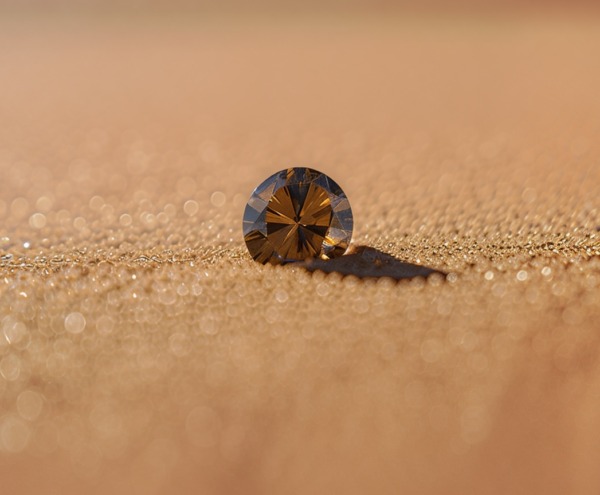
Dawn desert diamonds exist in that same register. Their palette of pale champagne, ivory, warm gold and soft amber sits at the lightest end of the desert diamond spectrum. For most of the last century, natural diamonds in this color range were graded down, its warmth seen as a departure from the ideal of colorlessness. What’s happened since is one of the more satisfying reversals in fine jewelry: we are celebrating these natural shade occurrences for the unique, one-of-a-kind luxury each one brings.
Dawn desert diamonds in nature, fashion and enduring taste
The 128.54-carat Tiffany Yellow Diamond has been at Tiffany & Co. since 1878, displayed in its New York flagship and worn by a small number of women (including Audrey Hepburn for the Breakfast at Tiffany’s promotional campaign and Lady Gaga to the 2019 Oscars). It is the most famous fancy yellow diamond in the world and, for most of its history, it was treated as something between a curiosity and an institution rather than a blueprint for what an engagement ring could look like.
That’s changed. And as yellow diamonds have moved from novelty to something people actually want to wear, an appetite has grown for natural diamonds that carry warmth without the full depth of color. Dawn Desert diamonds hit that note: not yellow, but yellowish, with a pale gold and champagne warmth that reads as considered rather than bold.


Warm diamonds add character
“We’ve had a lot of demand for subtly colored diamonds,”says jeweler Rachel Boston of emerging engagement ring trends. “Pale, buttery yellow, light champagne, or even cool grey and caramel-colored stones. Combining these pale central diamonds with traditional white diamond side stones is a really effective way to infuse a lot of character into a piece, with it still reading as a classic and timeless engagement ring.”

Warm tones throughout history
The shift is visible on the desert diamonds category’s own trajectory. Dawn is the palest shade in the family, and it’s the one that most directly challenges the 20th century’s notion about what a diamond should look like. It turns out the notion was wrong, or at least incomplete. The Victorians knew it: warm-toned old mine cut diamonds set in yellow gold were the standard of bridal jewelry for most of the 19th century. The mid-century pivot to colorless diamonds in platinum was a fashion choice, not an eternal truth.
A unique piece of the universe
Jean Schlumberger, who spent 20 years at Tiffany & Co. setting natural diamonds into birds, vines and sea creatures for clients including Bunny Mellon, Babe Paley and Jackie Kennedy, described his entire practice as an attempt to “capture the irregularity of the universe.”


A Dawn desert diamond carries that same logic. Its pale gold warmth isn’t uniform or perfect. It shifts with the light, deepens in the evening and brightens in the morning. It’s irregular in exactly the way Schlumberger meant. And it’s been there all along, waiting for everyone to catch up.
How to wear Dawn Desert diamonds
Dawn desert diamonds lend themselves to a more considered way of dressing. The color is subtle, so the way you wear it matters. It’s less about making a statement, more about how the piece settles into your overall look. Here’s how to incorporate them into your diamond jewelry collection:
- Monochromatic and warm: designer Sergio Hudson, speaking about the desert diamond color palette, put it simply: “I like monochromatic things. Seeing the same color family makes them stand out.” A Dawn diamond in yellow gold, worn with champagne studs, creates a tonal coherence that feels considered rather than matched.
- With white side stones: the pale champagne and ivory tone of Dawn diamonds work particularly well when flanked by colorless stones. The contrast makes the warm tone read more vividly against the cool white. A three-stone ring with a Dawn center and white diamond shoulders is one of the quieter triumphs of contemporary bridal jewelry.
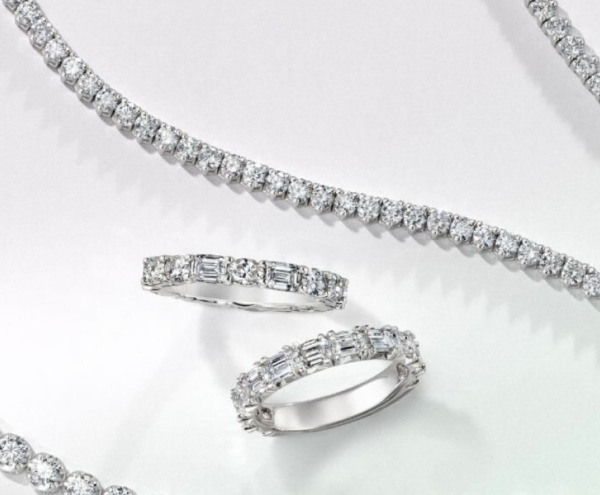
- Layered through the day: Dawn diamonds are legible in daylight in a way that deeper-colored gems aren’t. Stacked fine bands with Dawn diamond accents read as beautifully at a sun-soaked lunch as they do at an intimately lit dinner.
- Understated as the statement: the point of a Dawn Desert diamond is that it doesn’t announce itself from across the room. It rewards the people close enough to notice.
- As an engagement ring: a Dawn diamond solitaire in yellow gold is becoming a sought-out choice contemporary bridal jewelry. A 1 to 1.5 carat oval or cushion gives the color enough surface area to read clearly on the hand. It’s warm, it’s personal, and it looks nothing like what everyone else is wearing.


Inside the earth’s palette: the science behind Dawn Desert diamonds
The color in a Dawn desert diamond has a precise geological source: nitrogen. When nitrogen atoms replace carbon atoms in the crystal lattice during formation, they absorb blue light. The result, depending on concentration and arrangement, is the yellow-to-champagne spectrum. In Dawn diamonds the nitrogen concentration is low. Just enough to give the stone warmth, not enough to produce the saturated yellows of a canary diamond.

Understanding natural diamond formation is what makes the presence of the nitrogen genuinely interesting. Diamonds form approximately 140 to 200 kilometers below the earth’s surface, under temperatures exceeding 1,000 degrees Celsius. The nitrogen that gives a Dawn diamond its warmth entered the crystal during growth, billions of years ago, from the surrounding mantle environment. It wasn’t added or induced and can’t be replicated on demand. The pale gold of a Dawn diamond is a record of specific conditions in a specific place at a specific moment in geological time.
Why choose Dawn Desert diamonds
The pale sunrise hue doesn’t compete with seasons, skin tones, or what’s currently in fashion. It’s the kind of color that gets more personal as it accumulates more moments. The history of diamond engagement rings shows that warm-toned diamonds in yellow gold were the dominant choice for bridal jewelry through most of the 18th and 19th centuries, long before colorless became the standard. The Dawn diamond sits in that tradition.
As an heirloom diamond, it has the advantage of a color that’s been considered beautiful across completely different eras of taste. That’s a harder quality to find than it sounds.
Buying and caring for Dawn desert diamonds
When selecting a Dawn diamond, resist the instinct to lead with grading. The warmth that defines the Desert diamond palette is best assessed in person. Look for evenness of color distribution across the stone. Dawn diamonds are defined by their subtlety, and a well-cut stone will show that warmth clearly without needing depth or saturation to make its case.
The 4Cs of diamonds look different for warm-toned gems: cut and clarity do supporting work, but it’s color distribution that determines whether a Dawn diamond reads as beautiful or flat.
Always view the stone in multiple lighting conditions before buying. Dawn diamonds shift between different environments, they are brighter and more golden in daylight, softer and more amber in warm indoor light. The right gem should feel consistently inviting across all three. View it in the store’s overhead lighting, take it to a window and, if possible, see it in evening light.
Cut and setting
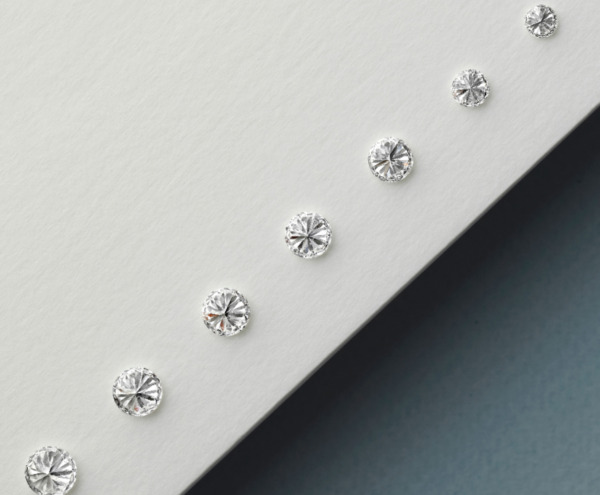
Oval, cushion and radiant cuts pool the color toward the center of the stone and tend to show the pale gold more vividly. Round brilliants maximize light dispersion, which brightens and lifts the perceived color but produces more sparkle than depth. Both are beautiful, the choice depends on whether you want the warmth or the fire to lead. For Dawn diamonds, most buyers find they want the warmth. Understanding how diamond cutting reveals a stone’s character matters particularly here, since the interaction between facet angles and pale color is direct and visible.

Yellow gold shares the stone’s tonal register and intensifies the warmth. White gold and platinum offer a cooler contrast that makes the pale hue read more distinctly. Both work, and the diamond crafting behind a well-set Dawn diamond is what truly sets a piece of jewelry apart. A slightly heavier claw or bezel shifts the entire mood of the stone.
Clarity and certification
Warm-toned diamonds are more forgiving of inclusions than colorless stones, as the color draws the eye rather than exposing flaws. Eye-clean is still the standard worth aiming for, but you can typically work with a lower clarity grade than you would for a white diamond without visible difference. GIA certification confirming natural color origin is the one non-negotiable. In the pale yellow and champagne range, where treatment is relatively common, that certification is what separates a Dawn desert diamond from an imitation of one. Do diamonds change color over time? Natural structural color does not. Treated color can. That difference — permanent versus potentially unstable — is exactly what the GIA report confirms.
First light, lasting beauty
Dawn desert diamonds challenge the idea that brilliance has to be colorless. Their warmth is subtle, but it holds. It shifts with the light, becoming brighter in the morning, deeper toward evening, always slightly different from one moment to the next.
What feels new about them isn’t the color itself, but the way it’s now being seen. For much of the last century, this part of the spectrum was overlooked in favor of something clearer, brighter and more uniform. That preference has changed. The appeal of a Dawn diamond sits in that shift as part of a growing appreciation for nuance, variation and uniqueness.
Each shade in the desert diamond palette tells a different story, from the sunlit warmth of Sand diamonds to the golden depth of Ochre diamonds to the rich, complex tones of Sunset Brown diamonds. Dawn is where the light begins.
Sources
- www.svs.gsfc.nasa.gov/ ↩︎
- www.en.wikipedia.org/wiki/Norham_Castle,_Sunrise/ ↩︎
- www.tiffany.com/high-jewelry/the-tiffany-diamond/ ↩︎
- www.fashion-news/fashion-scoops/feature/tiffany-and-co-yellow-diamond-history-beyonce-lady-gaga-audrey-hepburn/ ↩︎
- www.whowhatwear.com/living/wedding/engagement-ring-trends-2025/ ↩︎
- www.naturaldiamonds.com/diamond-engagement-rings/natural-diamond-rings/vintage-engagement-rings/ ↩︎
- www.naturaldiamonds.com/culture-and-style/jean-schlumberger/ ↩︎
- www.forbes.com/sites/roxannerobinson/de-beers-launches-desert-diamonds-campaign-with-splashy-new-york-event/ ↩︎
- www.adxdiamonds.com/blogs/trends/can-natural-diamonds-be-different-colors/ ↩︎
- https://diamondbuzz.blog/understanding-the-4cs-of-fancy-coloured-diamonds/ ↩︎
- www.ilacollection.com/blogs/news/how-the-shape-of-a-diamond-visually-affects-diamond-color/ ↩︎


