
Answer
Mughal cut diamonds belong to a historic cutting tradition associated with India during the Mughal era. Rather than following a standardized shape or facet pattern, cutters worked with the rough diamond’s natural form to create distinctive, irregular and asymmetrical forms. These diamonds are not only beautiful but carry centuries of story, artistry and symbolism.
Key takeaways
When were Mughal cut diamonds popular?
Mughal cut diamonds were popular in India during the 17th and 18th centuries. During this time, the Mughal Empire was a bustling center of wealth, art and gem collecting. India was also the world’s principal source of diamonds.
Natural diamonds were symbols of wealth and power at the Mughal court. Emperors Akbar, Jahangir and Shah Jahan amassed extraordinary collections of gems and jewelry. India’s diamond trade also attracted interest from Europe. French gem merchant Jean-Baptiste Tavernier documented India’s thriving diamond trade firsthand. He made six journeys to the region during the 17th century.

What craftsmanship techniques were used to cut Mughal diamonds?
Using skill and patience, Indian artisans shaped Mughal diamonds by hand. Rough diamonds were cleaved before being polished on wheels coated with abrasives such as emery or diamond powder. The process created the irregular, shallow facets Mughal diamonds were known for. Cutters generally aimed to retain as much of the original diamond weight as possible.
This labor-intensive approach produced a variety of shapes, including near-rectangular, lozenge, uneven oval and pear. The irregularity of the diamonds tells a story of both the natural diamond’s form and the cutter’s skill.

How do Mughal cut diamonds differ from modern cuts?
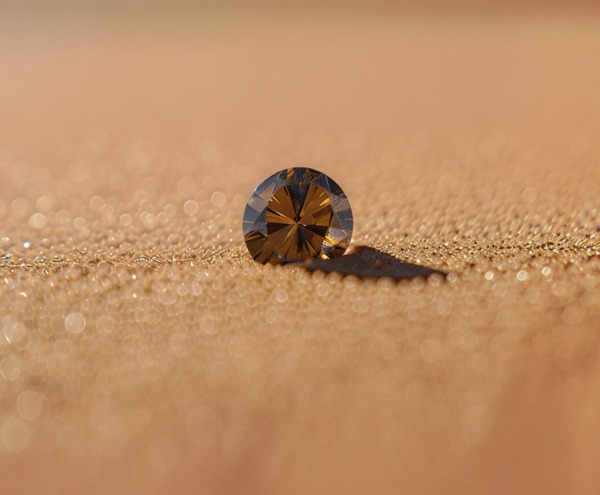
The standout feature of Mughal-cut diamonds is their lack of standardization. Every diamond has its own path with no prescribed outline or facet arrangement. Many historical examples are asymmetrical, with shallow facets and forms influenced by the original rough diamond.
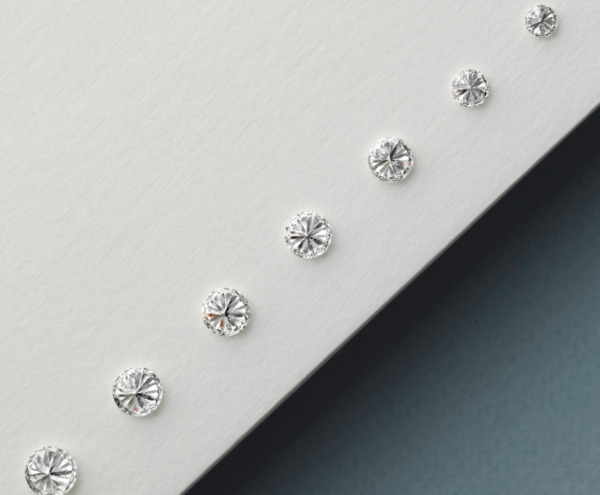
By contrast, a modern round brilliant cut is carefully engineered. Proportions are calculated, and facets are designed to maximize the way light travels through the diamond. Mughal cuts offer a more subtle visual experience honoring the natural form of the diamond. Because many were cut from exceptionally clear Golconda diamonds, they are often described as having a transparent, almost liquid-like glow.

Image credit: Christie’s Auction House

Image credit: Santi
How are Mughal diamonds valued?
There’s no standard price, and each Mughal cut diamond is assessed individually. Condition, provenance and the diamond’s individual characteristics are all taken into account. Historic examples with documented ownership and ties to important collections can also influence interest and value.
In 2019, Christie’s Maharajas & Mughal Magnificence sale achieved $109.3 million across almost 400 lots, making it the highest total for an auction of Indian art and Mughal objects at the time.

Image credit: Christie’s Auction House

Image credit: Christie’s Auction House
What are the most famous Mughal diamonds in existence?
Some of history’s most legendary natural diamonds (opens in a new window) are connected to Mughal India. The Great Mogul diamond was recorded by French gem merchant Jean-Baptiste Tavernier during his travels in India. It was once part of the Mughal treasury but its whereabouts today are unknown.
The 88.71-carat Shah Diamond offers a surviving link to the period. Its three Persian inscriptions record different owners, including the Mughal emperor, Shah Jahan. Today, it’s displayed in the Moscow’s Diamond Fund of Russia.
The Hope Diamond’s story also begins in Mughal-era India. Tavernier acquired a 112-carat blue diamond there and sold it to King Louis XIV, whose court jeweler recut it into the 67-carat French Blue. After the French Blue was stolen in 1792, a recut blue diamond surfaced in London. Researchers have concluded it is the 45.52-carat Hope Diamond (opens in a new window) we know today.


Image credit: @DiamondMuseum (Instagram)
Sources
- GIA. Polki Diamonds: A ‘New’ Fashion Statement from Mogul India. https://www.gia.edu/gia-news-research/polki-diamonds-new-fashion-statement-mogul-india (opens in a new window) Accessed October 6, 2026
- GIA. Polki Diamonds: A ‘New’ Fashion Statement from Mogul India. https://www.gia.edu/gia-news-research/polki-diamonds-new-fashion-statement-mogul-india (opens in a new window) Accessed October 6, 2026
- GIA. Gemstones in the Era of the Taj Mahal and the Mughals. https://www.gia.edu/gems-gemology/fall-2019-era-of-the-taj-mahal-and-mughals (opens in a new window) Accessed October 6, 2026
- GIA. Polki Diamonds: A ‘New’ Fashion Statement from Mogul India. https://www.gia.edu/gia-news-research/polki-diamonds-new-fashion-statement-mogul-india (opens in a new window) Accessed October 6, 2026
- GIA. Polki Diamonds: A ‘New’ Fashion Statement from Mogul India. https://www.gia.edu/gia-news-research/polki-diamonds-new-fashion-statement-mogul-india (opens in a new window) Accessed October 6, 2026
- GIA. Diamond Cut: Anatomy of a Brilliant Round. https://origin.prod.author.gia.edu/diamond-cut/diamond-cut-anatomy-round-brilliant (opens in a new window) Accessed October 7, 2026
- The Diamond Collective. Soul Over Sparkle: Why the Mughal Cut Is the Diamond of the Moment.
https://thediamondcollective.world/engagement-rings/mughal-cut/ (opens in a new window). Accessed Oct. 14, 2026. - GIA. Polki Diamonds: A ‘New’ Fashion Statement from Mogul India. https://www.gia.edu/gia-news-research/polki-diamonds-new-fashion-statement-mogul-india (opens in a new window) Accessed October 6, 2026
- Christies. Maharajas & Mughal Magnificence collection makes history in New York. https://www.christies.com/en/stories/auction-results-maharajas-mughal-magnifcence-collection-7c299420431d420996cb50ee422c5ba5 (opens in a new window)
Accessed October 6, 2026 - GIA. Gems & Gemology 2008. https://www.gia.edu/dam/jcr%3A812d3b9f-0334-4809-8c12-a19a79373543/SU08.pdf (opens in a new window) Accessed October 6, 2026
- ADIF. https://adiamondisforever.com/en-in/education/12-legendary-indian-diamonds-that-changed-the-world-of-jewellery/ Accessed October 6, 2026
- Smithsonian. History of the Hope Diamond. https://naturalhistory.si.edu/explore/collections/hope-diamond-history (opens in a new window) Accessed October 6, 2026


